

Posted by Enterosgel

An intestinal adsorbent can help remove harmful substances without binding the bacteria that produce them. How intestinal adsorbents work is straightforward: they bind selected substances in the gut, which then pass out of the body in stool. For diarrhoea, that distinction matters because the target may be bacterial toxins, not the bacteria themselves.
When you have loose stools or digestive discomfort, it’s reasonable to want to know what a treatment does inside your body. The NHS explains that Enterosgel captures harmful substances in the gut that can cause diarrhoea, then removes them in stool.
This article explains how oral intestinal adsorbents bind substances, how that differs from coating the gut lining, and how polymethylsiloxane polyhydrate works. You’ll also learn why an adsorbent acts locally in the digestive tract and what that means when considering support for diarrhoea.
Key Takeaways
- Understand how oral intestinal adsorbents bind selected substances in the gut so they can leave the body in stool.
- Learn why binding harmful compounds differs from coating the gut lining.
- See how capturing toxins from pathogenic bacteria may help reduce diarrhoea symptoms, without capturing the bacteria themselves.
- Discover how polymethylsiloxane polyhydrate fits into the action of an intestinal adsorbent.
- Find out how Enterosgel formats relate to support for diarrhoea and IBS-D.
Oral intestinal adsorbents and enterosorbents
Oral intestinal adsorbents, also called enterosorbents, act inside the digestive tract. Their role differs from replacing fluids or slowing bowel movements. Knowing the difference helps you understand what each approach does.
Binding and removal of toxins
Enterosorption means binding substances in the gut so they can pass out of the body in stool. The NHS explains that Enterosgel captures harmful substances that can cause diarrhoea and removes them in stool. In other words, substances are captured within the digestive tract and leave with bowel contents, rather than being absorbed into the body.
Mechanisms and types of enterosorbents
Enterosorbents are grouped by their materials and how they bind substances. Some bind compounds on their surface; others have a porous or gel structure that holds selected materials in the gut. This differs from an intestinal protectant, which coats the gut lining. UK Government product information distinguishes coating from binding chemical compounds to prevent their absorption.
How do intestinal adsorbents work in the gut? They contact selected substances in the digestive tract, bind them, and carry them out in stool. The exact targets depend on an adsorbent’s structure and formulation, so products in the same broad category may work differently.
Clinical use and treatment comparisons
The right approach depends on the symptom and treatment goal. Oral rehydration solution replaces water and salts lost through diarrhoea, while an adsorbent binds selected substances in the gut. Anti-diarrhoea medicines such as loperamide can slow bowel movements, a different action from binding material for removal.
Are intestinal adsorbents available over the counter in the UK, and what do they cost? Supply status depends on the individual product, so the category has no single over-the-counter rule. Costs also vary by product and pack; this article does not give product prices.
Risks, interactions and who should avoid them
Possible effects and precautions vary by product. Binding substances in the gut may also affect the absorption of other oral products, so read the instructions and ask a pharmacist about timing if you take medicines, supplements or oral contraceptives. Interaction advice is not the same for every adsorbent.
Can intestinal adsorbents interfere with medicines, supplements or oral contraceptives? They may affect absorption, so follow the product instructions and ask a pharmacist about spacing doses. Children, pregnant people and those with chronic conditions should follow the product-specific guidance and seek professional advice before use.
What are the side effects and risks of intestinal adsorbents? These vary by product and may include digestive effects. Follow the instructions and stop use if a concerning reaction occurs. Who should avoid them? Anyone with a relevant product warning or known sensitivity should avoid that product and seek advice.
When should someone with diarrhoea seek medical advice instead of using an intestinal adsorbent? Seek prompt advice for blood in the stool, severe pain, signs of dehydration, or symptoms that persist or worsen. These features need assessment, not just symptom relief.
Adsorbent mode of action
Adsorption is a surface process: substances attach to an adsorbent rather than entering its structure, as liquid does when soaking into a sponge. In the gut, this explains how a material can bind selected compounds while remaining in the digestive tract.
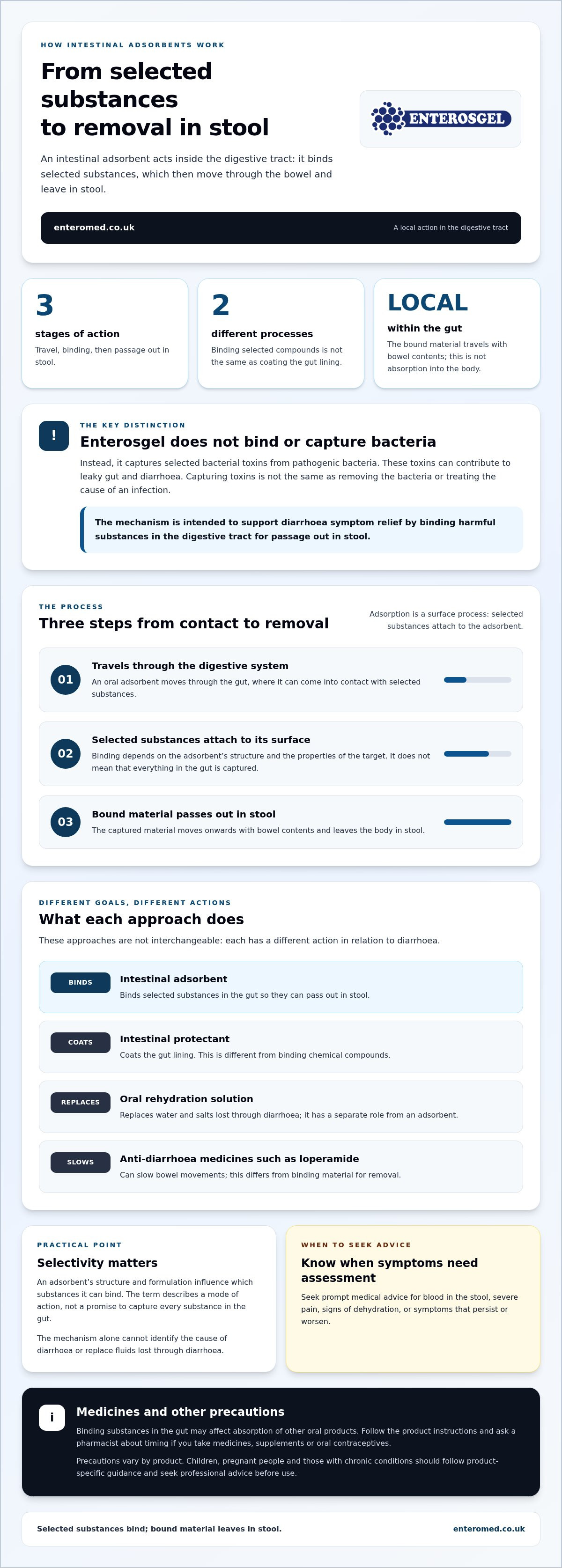
The process has three stages. First, an oral adsorbent travels through the digestive system. Next, selected substances contact its binding surface and attach. Finally, the bound material moves through the bowel and leaves in stool. The action stays local to the gut; it is not the same as a substance entering the bloodstream.
Binding depends on the properties of both the adsorbent and the target compound. Surface structure, chemical interactions and molecule size can influence which substances attach. That’s why “adsorbent” describes a mode of action, not a promise to capture everything in the gut. Different materials can bind different substances.
The UK Government distinguishes adsorbents from intestinal protectants: protectants coat the gut lining, while adsorbents bind chemical compounds to prevent their absorption. A coating forms a barrier over tissue; adsorption works through contact between a compound and a binding surface. The terms may sound similar because both describe actions in the gut, but the physical processes differ.
Adsorption also differs from absorption, which means movement into the body. A bound compound can travel onward with bowel contents, while an absorbed compound crosses into the body. This clarifies why an intestinal adsorbent is not intended to slow gut movement or coat the bowel wall.
The practical point is selectivity. A product’s intended action depends on what it can bind and how its instructions say to use it. The mechanism alone cannot identify the cause of diarrhoea or replace fluids lost through diarrhoea. Oral rehydration solution has a separate role: replacing water and salts.
Research on a specific adsorbent can help distinguish its proposed binding mechanism from the clinical outcomes examined in clinical research on Enterosgel.
Adsorption of bacterial toxins by intestinal adsorbents
Some pathogenic bacteria release toxins that can contribute to diarrhoea and disruption of the gut barrier, sometimes described as leaky gut. An intestinal adsorbent targets certain harmful substances in the digestive tract, not the bacteria themselves. The distinction matters: bacteria and their toxins are different targets, and binding toxins does not mean the underlying infection has been removed.
The process begins when an oral adsorbent meets toxins in the gut. Its binding structure can attach to selected compounds, forming material that passes onwards through the bowel and leaves in stool. Think of a surface that catches particular particles as they move past; it does not trap every substance or organism. The specific compounds an adsorbent can bind depend on its material and structure.
Why can this matter during diarrhoea? Bacterial toxins can affect the gut lining and contribute to loose stools. Capturing some toxins in the intestinal contents may reduce their contact with the gut and help ease a trigger for symptoms. The aim is symptom relief, including reducing diarrhoea duration and the number of loose stools. It does not replace fluids lost through diarrhoea.
Studies of adsorbents can test binding under controlled conditions and assess clinical outcomes separately. Laboratory tests show whether a material binds a substance under specific conditions; they do not, on their own, prove how much a person’s symptoms will change. Clinical research can assess stool consistency, loose-stool frequency and symptom duration. These measure different aspects of diarrhoea and are not interchangeable.
The practical distinction is straightforward: an adsorbent acts on selected substances in the gut, while rehydration addresses fluid loss. Neither action proves that bacteria have been captured or removed. If diarrhoea comes with concerning features, such as blood in the stool or signs of dehydration, toxin binding does not remove the need for medical assessment. Knowing the target helps set realistic expectations: an adsorbent may bind toxins, but it does not kill bacteria or identify the cause of illness.
Polymethylsiloxane polyhydrate
Polymethylsiloxane polyhydrate is Enterosgel’s active adsorbent material. It forms a gel structure that acts in the digestive tract, where its selective binding surface can capture certain substances. In simple terms, it works like a selective trap, not a net that catches everything passing through the gut.
Its binding can vary depending on the substance and conditions in the gut. This selectivity helps explain the intended action: capturing harmful compounds, including bacterial toxins, rather than binding bacteria themselves. Toxins from pathogenic bacteria can contribute to leaky gut and diarrhoea. Capturing these toxins may help reduce diarrhoea duration and the number of loose stools, but the material does not remove the cause of every episode.
The distinction matters in practice. Polymethylsiloxane polyhydrate acts locally in the gut, while fluid replacement addresses water and salts lost through diarrhoea. It does not kill bacteria or simply slow bowel movements. Follow the product instructions for use and timing, especially if taking other oral medicines.
Clinical findings provide context for its use. In the UK Enterosgel IBS-D trial, 49% of patients taking Enterosgel had improved stool consistency, compared with 33% taking placebo during the double-blind phase. Stool consistency is one outcome, not a measure of toxin binding itself; the study result should therefore be understood as a clinical finding rather than direct proof of the precise mechanism.
The same UK trial involved 440 people and included an 8-week double-blind phase. It examined Enterosgel for IBS-D, a condition where diarrhoea is the predominant bowel pattern. A separate open-label phase followed the blinded comparison. These details help distinguish controlled comparison from later observation, where participants knew they were receiving the product.
For acute diarrhoea, the intended role is to capture selected harmful substances in the gut and carry them out in stool. For ongoing IBS-D symptoms, the clinical question is broader: whether symptoms such as loose stools and abdominal discomfort improve over time. Clinical studies assess health outcomes, while proposed mechanisms describe how a material may act in the digestive tract. These are related but distinct kinds of evidence, as detailed in the clinical research on Enterosgel.
Enterosgel: Enterosgel 225g Tube
Enterosgel 225g Tube is an oral intestinal adsorbent for people seeking drug-free support with diarrhoea. It captures bacterial toxins from pathogenic bacteria, which can contribute to leaky gut and diarrhoea; it does not bind or capture bacteria. By capturing these toxins, it is intended to help reduce diarrhoea duration and the number of loose stools.
For recurring IBS-D symptoms, the Enterosgel IBS Starter pack includes a tube and sachets. Use the product according to its instructions; for IBS-D symptoms and daily usage, take it in 30-day courses, with each course followed by a short break. Enterosgel is a medical device, not a pharmaceutical medicine, and it does not replace rehydration or medical assessment when symptoms are concerning.
For product information or guidance on the instructions, contact Enterosgel through enteromed.co.uk.
Choose your next step with confidence
Understanding how intestinal adsorbents work can help you decide what to consider when choosing support for diarrhoea or IBS-D. Think about the symptoms you want to address, follow the product instructions, and seek medical advice for concerning or persistent symptoms.
Enterosgel is available as the Enterosgel 225g Tube, Enterosgel Sachets (Pack of 10) and Enterosgel Kids 0+. It captures bacterial toxins from pathogenic bacteria, not the bacteria themselves. For children under 3 years old, it is advisable to consult a doctor prior to use. The children’s product contains no sugar, gluten or preservatives; unlike other antidiarrhoeal drugs, Enterosgel is safe for children under 12 years.
For more information about the available options, visit enteromed.co.uk. A clear understanding of the product and its intended use can help you take your next step with care.
Frequently Asked Questions
How do intestinal adsorbents bind toxins, bacteria, or excess water?
Intestinal adsorbents bind selected substances; they don’t all capture bacteria or excess water. Enterosgel captures toxins produced by pathogenic bacteria, not the bacteria themselves. Other adsorbent materials have different binding properties, so their targets vary. Bound substances pass through the digestive tract with stool. This differs from oral rehydration solution, which replaces water and salts lost through diarrhoea rather than binding toxins.
Which intestinal adsorbents are used in the UK, such as diosmectite, activated charcoal, and kaolin?
Diosmectite, activated charcoal and kaolin are examples of substances described as adsorbents. They are not interchangeable: each has distinct properties and product instructions. Enterosgel uses polymethylsiloxane polyhydrate as its adsorbent material and is a medical device, not a pharmaceutical medicine. When considering a product in the UK, identify its active material and intended use on the packaging, then follow its own instructions rather than applying another adsorbent’s directions.
What conditions are intestinal adsorbents used to treat, and how effective are they?
Enterosgel is intended for diarrhoea and IBS-D symptoms, including urgency, bloating and abdominal pain. It captures selected harmful substances in the gut; it does not treat every possible cause of digestive symptoms. Effectiveness is assessed through clinical outcomes, such as changes in stool consistency and symptoms. An adsorbent does not replace fluids, and blood in the stool or signs of dehydration call for medical assessment.
How should intestinal adsorbents be taken, and what are typical doses?
Use an intestinal adsorbent according to the instructions for that specific product; there is no single dose for every material or age group. Enterosgel’s instructions say to dilute the specified amount in room-temperature water. Take it separately from meals as directed, and check the product guidance on spacing it from oral medicines. Do not use the dose for one adsorbent as a guide for another.
How long do intestinal adsorbents take to work, and how long should they be used?
Onset and duration depend on the product and the reason for use, so follow its instructions rather than relying on a general timetable. For ongoing IBS-D symptoms and daily use of Enterosgel, take it in 30-day courses, with each course followed by a short break. For acute diarrhoea, use the product as directed and seek medical advice if symptoms persist, worsen, or include concerning signs.


