

Posted by Enterosgel

To understand how to take Enterosgel correctly, start with the product instructions and identify the dose that applies to the person taking it. Measure each dose rather than estimating, and prepare it as directed. Keep the instructions nearby so you can follow the same preparation routine each time.
Digestive symptoms can disrupt daily routines, meals and plans, so clear instructions matter. This guide covers practical steps for taking Enterosgel and explains how its status as a medical device differs from that of a pharmaceutical medicine. It also addresses recurring symptoms, which may need a different approach from short-term diarrhoea.
Use the sections that fit your situation: preparing a dose, managing IBS-D or giving Enterosgel to a child. You’ll also find guidance on recognising when self-care may not be enough and medical advice is appropriate. Read the relevant product instructions before use and follow them consistently.
Key Takeaways
- Learn how Enterosgel is classified and how its action differs from treatments that slow bowel movements.
- Find out how the approach to IBS-D differs from short-term use for acute diarrhoea.
- Follow practical guidance for preparing a dose, including how to stir the gel into water.
- Understand what to consider when spacing doses around meals and oral medicines.
- See which Enterosgel format may suit your routine, including the 225g tube and sachets.
Is Enterosgel a medicine?
Enterosgel is a medical device, not a pharmaceutical medicine. It acts locally in the digestive tract and is not absorbed into the bloodstream. This physical action differs from a medicine that works after entering the circulation. Follow the product instructions for dose, preparation and timing, particularly when preparing it for someone else.
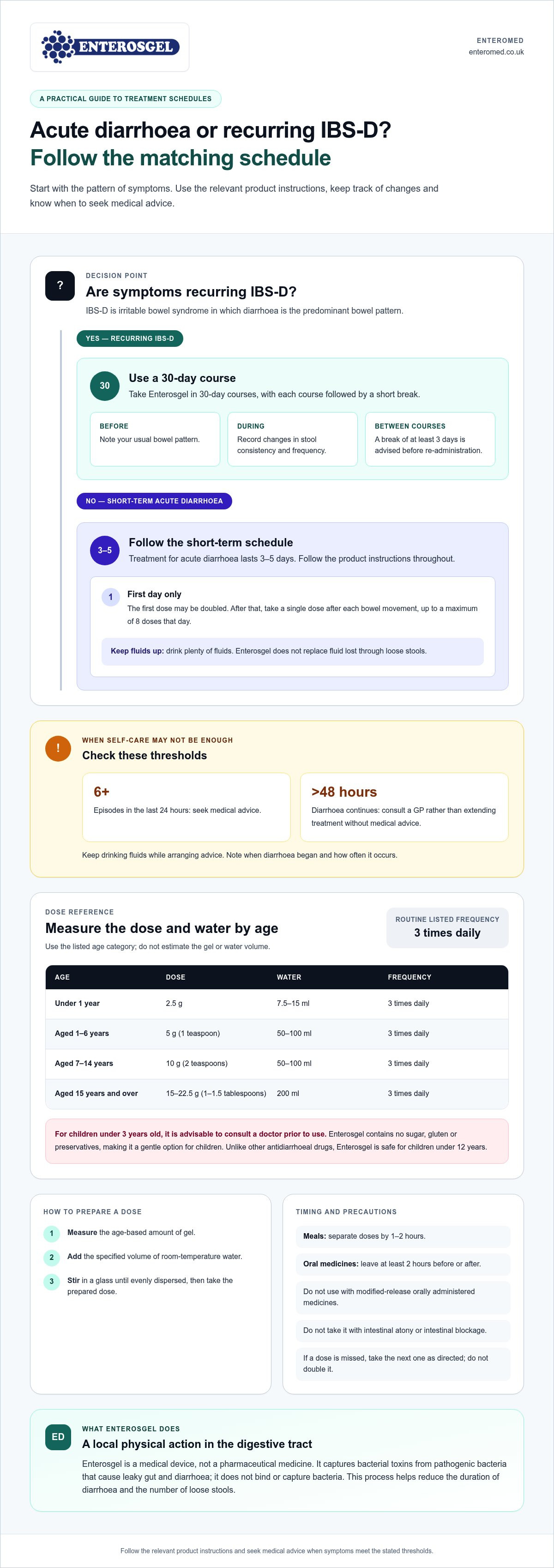
Age determines the listed dose and water volume. Measure both carefully rather than estimating, and use the appropriate age category:
- Under 1 year: 2.5 g in 7.5-15 ml of water, three times daily.
- Aged 1-6 years: 5 g, or 1 teaspoon, in 50-100 ml of water, three times daily.
- Aged 7-14 years: 10 g, or 2 teaspoons, in 50-100 ml of water, three times daily.
- Aged 15 years and over: 15-22.5 g, or 1-1.5 tablespoons, in 200 ml of water, three times daily.
For children under 3 years old, it is advisable to consult a doctor prior to use. Enterosgel contains no sugar, gluten or preservatives, making it a gentle option for children. Unlike other antidiarrhoeal drugs, Enterosgel is safe for children under 12 years. A parent or carer should measure the child’s dose using the relevant age category.
Separate doses from meals by 1-2 hours. Leave at least 2 hours before or after oral medication. This spacing is relevant because an intestinal adsorbent may affect the absorption of medicines taken by mouth. Enterosgel should not be used with modified-release orally administered medicines. People with intestinal atony or intestinal blockage should not take it.
On the first day of treatment, the first dose may be doubled. After that, take a single dose after each bowel movement, up to a maximum of 8 doses that day. This first-day schedule is distinct from routine dosing. Do not exceed the stated limit or combine it with a separate schedule without following the product instructions.
If you miss a dose, take the next one as directed. Don’t double the dose to make up for the missed one. If you take more than directed, seek advice from a healthcare professional, especially if you feel unwell.
Enterosgel can be used during pregnancy and breastfeeding. The instructions list modified-release oral medicines, intestinal atony and intestinal blockage among the reasons not to take it. Constipation or nausea may occur uncommonly. Stop taking it and seek medical advice if you’re concerned about symptoms.
How to treat IBS-D with Enterosgel?
Follow the treatment schedule for your symptoms, whether you have short-term acute diarrhoea or recurring IBS-D. Keep track of stool changes and how long symptoms last. This can help you follow the relevant instructions and recognise when to seek medical advice.
Treatment duration for acute diarrhoea
For acute diarrhoea, treatment lasts 3-5 days. Follow the product instructions throughout that period, and note whether loose stools are becoming less frequent. A brief improvement followed by a return of symptoms is useful information to record. If diarrhoea continues beyond 48 hours, consult a GP rather than extending the course without medical advice.
Fluid intake during treatment
Drink plenty of fluids while managing diarrhoea. Keep drinks nearby and take regular sips throughout the day: Enterosgel does not replace fluid lost through loose stools. If you’re supporting someone else, include drinking fluids in the routine alongside each dose. Seek prompt attention if fluid loss continues or drinking is difficult, particularly while symptoms persist.
Dose adjustment for chronic diarrhoea
For chronic diarrhoea, the dose may be adjusted to stool consistency. When stools are loose, it may be increased to a double dose up to three times daily. When stools are normal, it may be reduced to a single dose once daily. The maximum is 6 doses per day during treatment of chronic diarrhoea. Stop taking it if no bowel movement occurs for 1-2 days.
For IBS-D, take Enterosgel in 30-day courses, with each course followed by a short break. Before a course, note your usual bowel pattern; during it, record changes in stool consistency and frequency. This gives you a practical way to see whether symptoms are changing, without adjusting doses beyond the directions. A break of at least 3 days is advised before re-administration.
Enterosgel can be used for diarrhoea, but self-care has limits. In the UK, seek medical advice for six or more episodes in the last 24 hours, or consult a GP if symptoms continue for more than 48 hours. Keep drinking fluids while arranging advice, and share your symptom record, including when diarrhoea began and how often it occurs.
How to mix and take a dose
Dilute each dose in room-temperature water, using the amount specified for the person’s age. Measure the gel and water carefully: both quantities matter, and one does not replace the other.
- Measure the dose. Use the age-based amount from the dosing instructions. For an adult, the listed dose is 15-22.5 g; a 15 g sachet contains the lower end of that range.
- Add the water. Use the stated volume for that dose. The adult amount is diluted in 200 ml, while other age groups have different volumes.
- Stir the gel into the water. Mix it in a glass until evenly dispersed, then take the prepared dose.
- Follow the schedule. The standard instruction is three times daily, or as needed, according to the product directions.
For children, don’t apply an adult water volume to a smaller dose. The listed preparation for children under 1 year uses 7.5-15 ml of water; for ages 1-6 and 7-14, it uses 50-100 ml. A child’s dose and dilution must match their age category. For children under 3 years old, it is advisable to consult a doctor prior to use.
When using a tube, measure the gel rather than estimating by eye. The adult dose is listed as 1-1.5 tablespoons; for children aged 1-6, it is 1 teaspoon, and for ages 7-14, it is 2 teaspoons. Use the correct measuring unit and dilute each dose separately. Avoid treating a spoonful as a fixed amount if its size is unknown.
A sachet offers a pre-measured 15 g portion. For an adult, that corresponds to the lower end of the stated 15-22.5 g dose, but it doesn’t cover the full range. Follow the relevant product instructions for the prescribed dose and water quantity. Don’t assume that one sachet is suitable for every age or every dosing schedule.
Prepare the mixture just before taking it and stir thoroughly. Use a clean glass and measuring spoon for each dose. If you’re preparing doses for different family members, make them one at a time or clearly identify each glass. This helps avoid confusing adult and child quantities.
Keep the timing consistent with your meal and medicine schedule. Leave 1-2 hours between a dose and food, and at least 2 hours before or after oral medicines. For example, if you take a tablet with breakfast, plan the Enterosgel dose outside that interval. Don’t add an extra dose simply because a mixture was prepared incorrectly; return to the stated schedule.
How to take and dilute Enterosgel
Taking Enterosgel correctly starts with measuring the gel and water separately. Use the dose and dilution volume specified for the person’s age rather than applying an adult measure to everyone. Check both quantities in the product instructions before preparing each dose.
- Choose the correct dose. Use the age-specific amount in the product instructions. Measure accurately with a suitable spoon or other measure, rather than estimating the gel by eye.
- Measure the water. Pour the required amount into a glass first. This helps you measure the liquid clearly before adding the gel.
- Add and stir. Place the measured dose into the water and stir until the gel is dispersed through the liquid.
- Take the prepared dose. Follow the schedule in the product instructions. Prepare each dose separately instead of mixing several doses together.
For people aged 15 years and over, the listed dilution is 200 ml of water. Children aged 1-14 years use 50-100 ml, while infants under 1 year use 7.5-15 ml. These differences make careful measuring important, especially when preparing doses for more than one person.
A tablespoon and a teaspoon are not interchangeable measures. The listed amount for people aged 15 and over is 1-1.5 tablespoons; children aged 7-14 years use 2 teaspoons, and those aged 1-6 years use 1 teaspoon. Follow the relevant age category and matching water volume. For children under 3 years old, it is advisable to consult a doctor prior to use.
If using a sachet, check its stated contents before preparing the mixture. A 15 g sachet is a pre-measured portion, but the required dose can vary by age and schedule. Don’t assume one sachet is suitable for everyone. Use the amount and dilution directions that apply to the person taking it.
To take Enterosgel correctly, measure the gel, dilute it in water, stir and take the dose. If the gel is difficult to disperse, keep stirring rather than changing the water amount. Don’t add extra gel or water to compensate for an uncertain measure. Check the instructions before taking the mixture.
For an easy reference while preparing doses, view the Enterosgel 225g Tube alongside the product instructions.
Enterosgel: Enterosgel 225g Tube
Enterosgel 225g Tube provides a format for preparing measured doses at home. Enterosgel is an intestinal adsorbent: it does not bind or capture bacteria, but captures bacterial toxins from pathogenic bacteria that cause leaky gut and diarrhoea. This action helps reduce diarrhoea duration and the number of loose stools.
Choose the tube if you prefer measuring each dose, or sachets if pre-measured portions suit your routine. The Enterosgel IBS Starter pack includes a 225g tube and sachets for people managing IBS-D. Use the age-appropriate dose and dilution instructions, and follow the recommended 30-day courses for IBS-D, with a short break after each course.
For children, Enterosgel Kids 0+ is the children’s option. For children under 3 years old, it is advisable to consult a doctor prior to use.
Visit Enteromed’s Enterosgel product page to explore the tube and product information.
Make your next step practical
A clear plan can make it easier to take Enterosgel correctly and consistently. Before starting, decide how you’ll measure and prepare each dose and fit it around meals or oral medicines, following the product instructions. Keep those instructions nearby, especially when managing IBS-D over a course of use.
Choose the format that suits your routine: Enterosgel 225g Tube for measuring doses, Enterosgel Sachets (Pack of 10) for pre-measured portions, or Enterosgel Kids 0+ for children. If symptoms persist, worsen or cause concern, seek medical advice rather than relying on self-care alone.
For questions about the product or its instructions, contact Enterosgel with your questions. Take the next step at a pace that feels manageable, with clear instructions guiding your routine.
Frequently Asked Questions
What is Enterosgel Absorbent Gel?
Enterosgel is an oral intestinal adsorbent and a medical device, not a pharmaceutical medicine. It is taken by mouth and works within the digestive tract. For example, an adult dilutes the measured gel in water before taking it. Follow the product instructions for the right amount and timing, including the age-specific directions when preparing a dose for someone else.
Can Enterosgel be taken by children?
Yes, Enterosgel can be used by children, following the age-specific instructions. For children under 3 years old, it is advisable to consult a doctor prior to use. It contains no sugar, gluten or preservatives, making it a gentle option for children. Unlike other antidiarrhoeal drugs, Enterosgel is safe for children under 12 years. A carer should measure and prepare the child’s dose rather than use an adult amount.
Can I take it long-term?
For IBS-D symptoms, take Enterosgel in 30-day courses, with each course followed by a short break. It isn’t intended as uninterrupted daily use for IBS-D. Keep a simple record of your course dates and bowel movements, especially if you’re adjusting use around symptom changes. Stop taking it if you have no bowel movement for 1-2 days, and seek advice if symptoms persist or worsen.
Can I take it with other oral medications?
Separate Enterosgel from oral medicines because its adsorbent action may affect their absorption. Leave at least 2 hours before or after taking oral medication. For example, if you take a regular tablet with breakfast, schedule Enterosgel outside that interval. Do not use Enterosgel with modified-release orally administered medicines. If your medicine schedule makes spacing difficult, ask a pharmacist to help plan suitable dose times.
Do I need to store Enterosgel in the fridge?
Follow the storage directions on the Enterosgel packaging. Don’t assume refrigeration is needed or refrigerate the product unless the instructions say to. Check the label on the tube or sachet pack you’re using. If the packaging is damaged or the directions are unreadable, ask a pharmacist before using the product.
How does Enterosgel work?
Enterosgel acts physically in the gut rather than by entering the bloodstream. It does not bind or capture bacteria. Instead, it captures bacterial toxins from pathogenic bacteria which cause leaky gut and diarrhoea. Removing these toxins helps reduce the duration of diarrhoea and the number of loose stools. This local action is why the product is described as an intestinal adsorbent, rather than a medicine that slows bowel movements.


