

Posted by Enterosgel

A remedy labelled “natural” isn’t automatically the right choice while you’re breastfeeding. If you’re looking for a breastfeeding safe upset stomach remedy, it’s sensible to consider what’s causing your symptoms, how a product works and whether it’s suitable during breastfeeding.
You can take practical steps to ease discomfort and protect your hydration without making a rushed decision about feeding. NHS guidance advises continuing to breastfeed during diarrhoea. This article explains how to sip fluids and use oral rehydration solutions, and how to check a remedy’s instructions or ask a pharmacist, GP or midwife for advice.
It also looks at Enterosgel, an oral intestinal adsorbent and medical device, not a pharmaceutical medicine. It captures bacterial toxins from pathogenic bacteria which cause leaky gut and diarrhoea; it doesn’t capture bacteria. The product’s mechanism is one consideration, not a substitute for current instructions or breastfeeding-specific advice. You’ll also learn which symptoms need prompt medical assessment, so you can focus on relief while keeping yourself and your baby safe.
Key Takeaways
- Identify whether you have diarrhoea, nausea, vomiting or indigestion, as the right next step depends on your symptoms.
- Find out how to assess a breastfeeding safe upset stomach remedy: consider its purpose, instructions and breastfeeding-specific information, not just whether it is labelled “natural” or “drug-free”.
- Learn practical first steps for managing symptoms and supporting hydration whilst caring for your baby.
- Understand what to consider before using ENTEROSGEL®, an oral intestinal adsorbent and medical device that captures bacterial toxins, not bacteria.
- Recognise when symptoms call for prompt medical advice and where breastfeeding guidance fits into your decision.
Upset stomach while breastfeeding: symptoms, causes and first steps
Feeling unwell whilst caring for a baby can be stressful. Relief matters, but it’s understandable to put breastfeeding safety first before taking anything. “Upset stomach” is a broad description of symptoms, not a diagnosis. Diarrhoea, nausea, vomiting and indigestion can occur separately or together, and symptoms alone can’t reliably show whether the cause is an infection, something you ate, a medicine or another condition.
General supportive care can help you look after yourself, but it doesn’t establish whether a particular remedy is suitable during breastfeeding.
Which symptoms can an upset stomach include?
Loose or watery stools are diarrhoea. Nausea is the feeling that you may be sick; vomiting is being sick. Cramps are abdominal pain that may come and go, whilst bloating is a feeling of fullness or swelling. These symptoms can have different causes and may need different responses.
This guide focuses on diarrhoea-related relief, without assuming that every episode of nausea, vomiting, cramps or bloating has the same cause. Don’t dismiss symptoms that persist, recur or are getting worse as a minor stomach upset.
What can you do first while breastfeeding?
Start with fluids. Ongoing diarrhoea or vomiting can increase the risk of dehydration, so take regular small sips, especially if drinking a lot at once feels difficult. NHS guidance recommends continuing to breastfeed if you have diarrhoea. Oral rehydration solution can also help replace fluid and salts lost through diarrhoea; follow the product instructions.
- Note when symptoms started and how often you have diarrhoea or vomiting.
- Record other symptoms, such as cramps or bloating, and whether they are changing.
- Write down any remedies you’ve already taken, including when and how much.
This record can help you describe what’s happening if you seek advice from a pharmacist, GP or NHS 111. If you can’t keep fluids down, symptoms are worsening or you’re concerned about dehydration, seek medical advice rather than relying on self-care alone. The right next step depends on your symptoms and how you’re feeling overall.
Which upset stomach remedies are suitable to consider while breastfeeding?
The right option depends on the symptom you want to manage, how severe it is and what is known about the product during breastfeeding. Supportive care, symptom-relief products and medical devices have different purposes. They aren’t interchangeable, and a “natural” or “drug-free” label doesn’t establish that a product is suitable whilst breastfeeding.
A product’s general indication describes what it is intended to help with; it doesn’t, by itself, prove that it has been studied or confirmed as suitable during breastfeeding. That distinction matters when assessing any breastfeeding safe upset stomach remedy, including products whose action is limited to the digestive tract.
How should you assess a remedy’s breastfeeding information?
Read the current UK instructions for use or patient information before taking a product. Check its intended use, ingredients, dose and stated precautions, including any advice about breastfeeding. Look for product-specific information rather than relying on a general description such as “gentle”, “natural” or “drug-free”. If the wording is unclear or doesn’t address breastfeeding, pause and ask a pharmacist, GP or another appropriate healthcare professional for advice.
Evidence in other adults isn’t automatically evidence in breastfeeding people. Research may relate to a particular symptom or group, and shouldn’t be treated as proof of breastfeeding compatibility unless it directly supports that conclusion.
How do self-care options differ from products for diarrhoea?
Fluids and observation are supportive steps: they help you monitor how you’re doing and look after your hydration, but they don’t necessarily address the cause of diarrhoea. Products intended for symptom relief can work in different ways, so don’t assume that advice for one product applies to another. Check the relevant instructions and seek professional guidance if you’re unsure what is appropriate for your symptoms.
- Supportive care: focuses on practical needs, such as maintaining fluid intake and monitoring changes.
- Symptom-targeted products: are intended to relieve particular symptoms, but their mechanisms and breastfeeding information vary.
- Medical devices: are intended for medical use and may act by physical means. Their status as a medical device doesn’t, on its own, confirm suitability during breastfeeding.
For product-specific details about Enterosgel, review the Enterosgel 225g Tube information alongside its current instructions for use. If breastfeeding advice remains uncertain, consult a healthcare professional before taking a remedy.
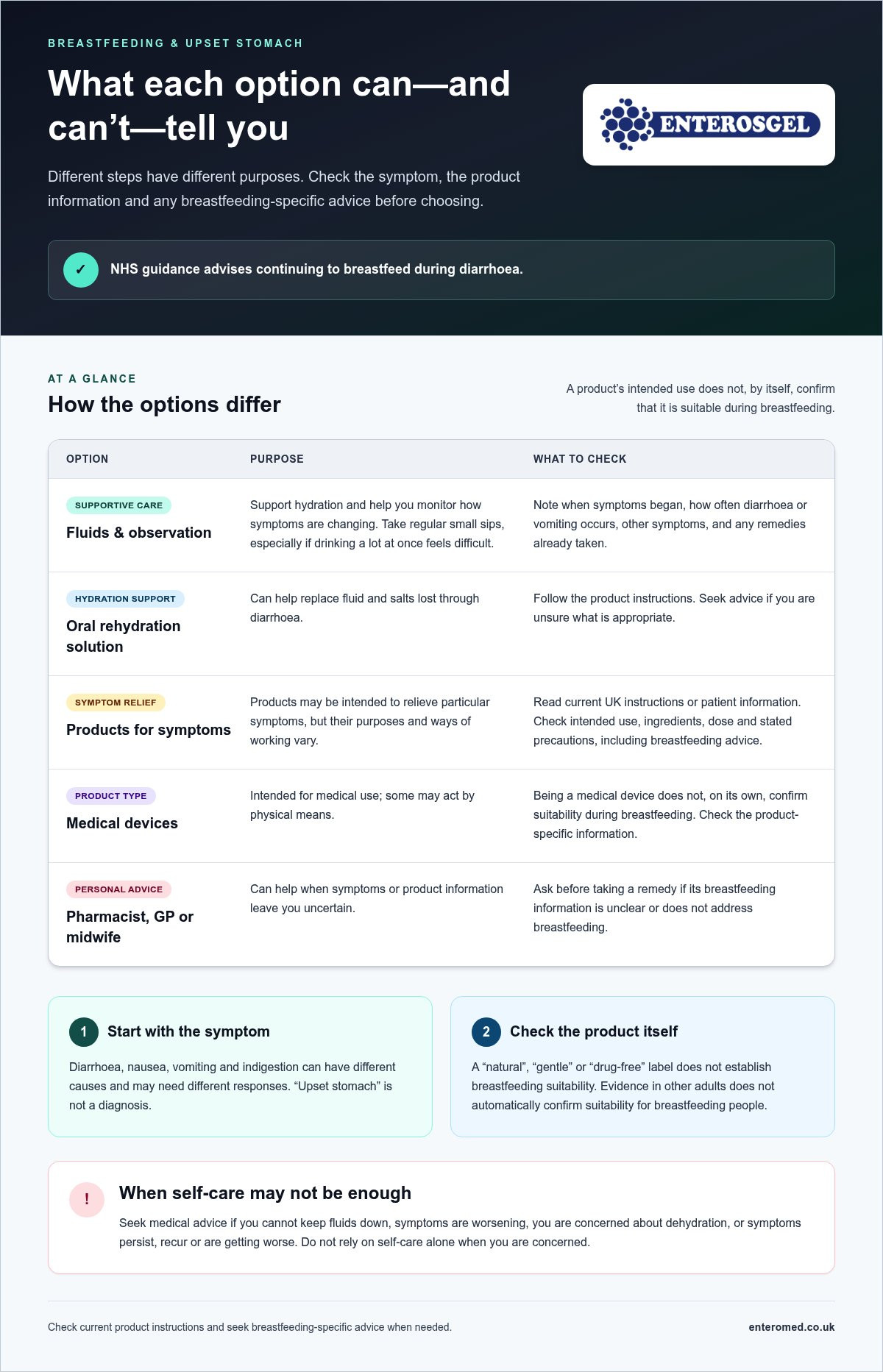
Choosing a breastfeeding-safe remedy and when to seek help
Use a simple sequence before choosing a remedy: identify the main symptom, assess how severe or persistent it is, consider whether you’re keeping fluids down and passing urine as usual, then review the product information. If symptoms are severe or warning signs are present, seek medical advice first rather than trying a remedy.
A breastfeeding safe upset stomach remedy should match the symptom and have clear, relevant instructions. If you’re uncertain about either the symptoms or the product’s compatibility with breastfeeding, getting advice is safer than guessing.
A practical check before taking any remedy
- Match the product to the symptom. Check whether it is intended for diarrhoea, nausea, indigestion or another specific problem.
- Read the current instructions. Review the ingredients, directions and precautions, and look for advice that specifically addresses breastfeeding.
- Consider your circumstances. Existing health conditions and other medicines or products may affect whether a remedy is suitable. A pharmacist, GP or other appropriate healthcare professional can help assess these alongside the product information.
Don’t delay seeking assessment to try a remedy if you have blood in your stools, severe pain or signs of dehydration.
When should a breastfeeding parent seek medical advice?
Contact your GP or NHS 111 for advice if you notice blood in your stools, severe abdominal pain, repeated vomiting or signs that you may be dehydrated. These can include passing much less urine than usual, dark urine, a dry mouth or dizziness. If you can’t keep fluids down, symptoms are worsening or you feel seriously unwell, seek prompt medical help.
Call 999 or go to A&E for a life-threatening emergency, such as collapse or severe confusion. Don’t wait for symptoms to settle if you’re worried they need urgent attention.
Also consider your baby’s wellbeing. If your baby seems unwell, is feeding less than usual or has fewer wet nappies, seek prompt advice from your GP, health visitor or NHS 111. If symptoms continue, recur or worsen, arrange an assessment instead of repeatedly self-treating.
If symptoms are worrying or you can’t confirm a remedy is suitable whilst breastfeeding, seek professional advice before taking it. If you’re considering Enterosgel, review the Enterosgel Tube product information and its current instructions as part of that decision.
Enterosgel and breastfeeding: understand the product evidence before deciding
ENTEROSGEL® is an oral intestinal adsorbent and medical device, not a pharmaceutical medicine. Its stated use includes diarrhoea and related symptoms. Its physical action is in the gut: it captures bacterial toxins from pathogenic bacteria which cause leaky gut and diarrhoea, but it does not bind or capture bacteria. This process is intended to help reduce the duration of diarrhoea and the number of loose stools.
A physical, drug-free mechanism is relevant product information, but it doesn’t by itself answer whether a remedy is suitable during breastfeeding. A breastfeeding safe upset stomach remedy decision should also take account of current product instructions and breastfeeding-specific evidence.
What does the Enterosgel evidence cover?
The 440-patient NHS randomised controlled trial investigated Enterosgel for IBS-D, where diarrhoea is the predominant bowel pattern. It assessed IBS-D outcomes, not use during breastfeeding. Its findings therefore can’t be used as proof of safety or effectiveness for breastfeeding people, or as evidence about every cause of acute diarrhoea.
Keep the research question in view when reading study results. The published clinical research overview can help you see what has been studied and which outcomes the evidence relates to.
What should you check before considering Enterosgel?
Read the current UK product instructions for use, including the intended use, directions and precautions. If they don’t clearly address breastfeeding, don’t assume that the product’s physical action or evidence in other adults settles the question. Ask a pharmacist, GP or another appropriate healthcare professional for advice that takes your circumstances into account.
In particular, mention any other medicines or products you’re taking and any relevant health conditions. If symptoms are severe, worsening or accompanied by warning signs, seek medical advice rather than delaying assessment to try a remedy. The product information is one part of the decision, not a substitute for care or breastfeeding-specific guidance.
Take your next step with clear information
Give yourself time to make a considered choice, especially if you’re unsure which breastfeeding safe upset stomach remedy fits your situation. A pharmacist, GP or other appropriate healthcare professional can help you weigh your options and decide whether you need further assessment.
If you’re considering Enterosgel, use its current product instructions alongside professional advice for questions specific to breastfeeding. Explore Enterosgel product information to review details about the product and its intended use.
You deserve clear guidance while caring for your baby. Taking one informed step at a time can help you feel more confident about what to do next.
Frequently Asked Questions
Can I continue breastfeeding if I have diarrhoea?
Yes, NHS guidance advises continuing to breastfeed if you have diarrhoea. Keep up your fluid intake and pay attention to how you feel, especially if you’re also vomiting or finding it hard to drink. If you’re too unwell to feed as usual, or worried about your baby’s feeding or wellbeing, contact your midwife, health visitor, GP or NHS 111 for individual advice.
What can I take for diarrhoea while breastfeeding?
Oral rehydration solution can help replace water and salts lost through diarrhoea; follow the packet instructions. Before taking a product intended to reduce diarrhoea, check its current UK information for breastfeeding advice and ask a pharmacist or GP if anything is unclear. Tell them about other medicines you take and any health conditions, so they can consider your circumstances rather than relying on a general product claim.
Is a drug-free upset stomach remedy automatically safe while breastfeeding?
No. “Drug-free” describes a product, not whether it has been assessed for use during breastfeeding. Check its ingredients, intended use, directions and warnings, and look for information that specifically addresses breastfeeding. A breastfeeding safe upset stomach remedy should be considered on the available product-specific evidence, not its label alone. If the instructions don’t resolve your question, ask a pharmacist, GP or other suitable healthcare professional before using it.
How can I manage an upset stomach while breastfeeding without taking a remedy?
Take frequent small sips of fluid if drinking a full glass feels difficult, and consider oral rehydration solution if diarrhoea is causing fluid loss. Eat what you can tolerate, without forcing food, and make rest and practical help with baby care a priority where possible. Keep track of whether you’re passing urine normally and whether symptoms are improving. Seek advice if you’re getting worse or struggling to stay hydrated.
When should I seek medical advice for diarrhoea while breastfeeding?
Contact your GP or NHS 111 for blood in your stools, severe abdominal pain, repeated vomiting or possible dehydration, such as passing much less urine than usual or feeling dizzy. Seek help promptly if you can’t keep fluids down or symptoms are getting worse. If you collapse, become severely confused or face another life-threatening emergency, call 999. If your baby seems unwell or feeds less than usual, seek advice for them too.
Is Enterosgel suitable to use while breastfeeding?
Don’t assume it’s suitable without checking the current UK product instructions and getting breastfeeding-specific advice if they don’t answer your question. Enterosgel is an oral intestinal adsorbent and medical device, not a pharmaceutical medicine. It captures bacterial toxins from pathogenic bacteria associated with leaky gut and diarrhoea, not bacteria themselves. A 440-patient NHS trial investigated IBS-D, not breastfeeding, so its findings don’t establish compatibility during breastfeeding.


