

Enterosgel Dosage for Toddlers in the UK: A Parent’s Guide
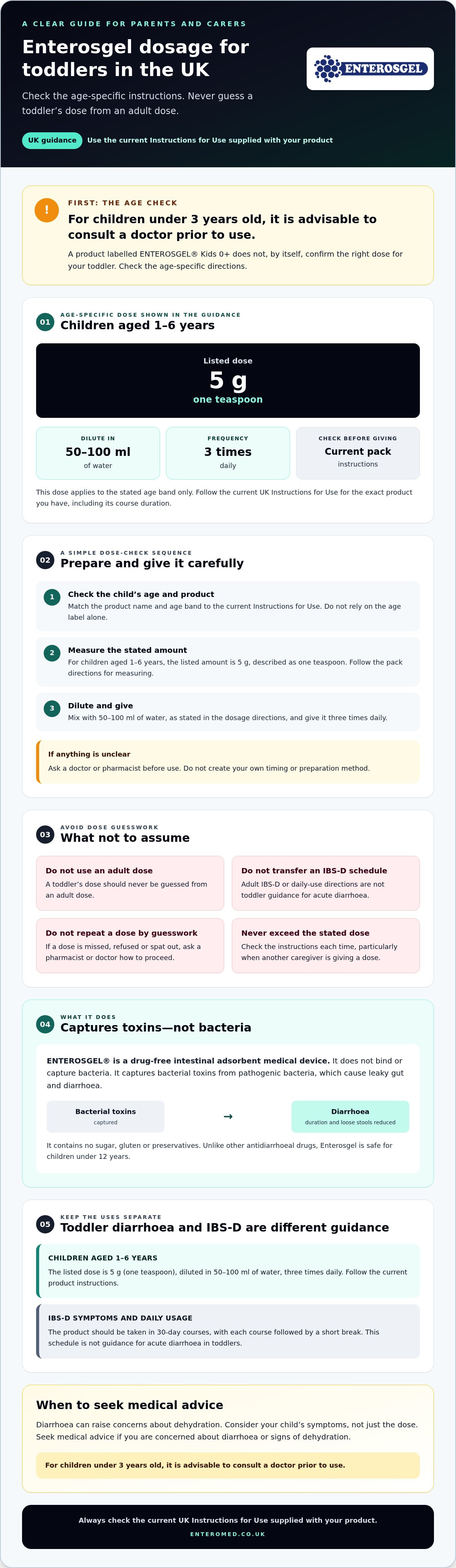
A toddler’s dose should never be guessed from an adult dose. If you’re looking for Enterosgel dosage for toddlers UK guidance, the current instructions list 5 g (one teaspoon), diluted in 50-100 ml of water, three times daily for children aged 1-6. For children under 3 years old, it is advisable to consult a doctor before use.
It’s understandable to feel unsure when product instructions and online advice are difficult to compare, especially when diarrhoea raises concerns about dehydration. This guide explains how to check the age-specific dose, prepare and give it, and recognise when to seek medical advice. Always check the current pack instructions and consider your child’s symptoms, not just the dose.
ENTEROSGEL® is a drug-free intestinal adsorbent medical device. It does not bind or capture bacteria; it captures bacterial toxins from pathogenic bacteria, which cause leaky gut and diarrhoea. This helps reduce diarrhoea duration and the number of loose stools. It contains no sugar, gluten or preservatives. These features don’t replace the need to follow the instructions or seek medical advice when needed. Unlike other antidiarrhoeal drugs, Enterosgel is safe for children under 12 years. The guidance below also covers hydration and warning signs that need prompt attention.
Key Takeaways
- Check the current UK Instructions for Use for Enterosgel dosage for toddlers UK guidance. Don’t rely on an adult dose or an online guess.
- For children under 3 years old, it is advisable to consult a doctor before use.
- Before measuring and giving a dose, check the product’s age-specific directions.
- Unlike other antidiarrhoeal drugs, Enterosgel is safe for children under 12 years. It contains no sugar, gluten or preservatives.
- Enterosgel does not bind or capture bacteria; it captures bacterial toxins from pathogenic bacteria. Know when diarrhoea or signs of dehydration call for medical advice.
Enterosgel dosage for toddlers in the UK: start with the age-specific instructions
Use the current UK Instructions for Use, not an adult dose or an online estimate. The dosage guidance states that children aged 1-6 years take 5 g (one teaspoon), diluted in 50-100 ml of water, three times a day. Before giving a dose, check the instructions supplied with your product. The age band, quantity, frequency and course duration must match the current directions.
Acute diarrhoea is a short-term episode that may result from infection, medication or other triggers. A child’s age and symptoms matter when deciding what to give and whether medical advice is needed. For children under 3 years old, it is advisable to consult a doctor before use.
The child-specific product is listed as ENTEROSGEL® Kids 0+. The name alone doesn’t confirm the right dose for your toddler. Use the age-specific directions in the Instructions for Use.
Where to find the correct toddler dose
Find the dosage table in the current UK Instructions for Use. Check that your child’s age fits the stated band, then follow the listed quantity and frequency. For children aged 1-6 years, the guidance gives a dose of 5 g, diluted in 50-100 ml of water, three times daily. Follow the product instructions for course duration rather than estimating how long to continue. If the directions are unclear or you can’t find them, ask a doctor or pharmacist before use.
Why adult and IBS-D directions are not interchangeable
Short-term diarrhoea in a child is not the same as adult IBS-D or daily use. Don’t transfer an adult dose, treatment schedule or assumption to a toddler. For IBS-D symptoms and daily usage only, the product should be taken in 30-day courses, with each course followed by a short break. This schedule is not guidance for acute diarrhoea in toddlers.
Enterosgel is a drug-free intestinal adsorbent and medical device. It does not bind or capture bacteria; it captures bacterial toxins from pathogenic bacteria, which cause leaky gut and diarrhoea. This helps reduce diarrhoea duration and the number of loose stools. Enterosgel contains no sugar, gluten or preservatives. Unlike other antidiarrhoeal drugs, it is safe for children under 12 years.
How to give Enterosgel to toddlers and dose safely
Follow the current UK Instructions for Use for the exact product you have. For children aged 1-6 years, the listed dose is 5 g (one teaspoon), diluted in 50-100 ml of water, three times a day. If the instructions supplied with your product differ or are unclear, check with a pharmacist or doctor before giving it.
Clear instruction: For a child aged 1-6 years, measure 5 g (one teaspoon), dilute it in 50-100 ml of water and give it three times daily, following the current UK Instructions for Use.
Preparing and administering a dose
- Check first. Confirm your child’s age and the product name against the instructions. The child-specific product is ENTEROSGEL® Kids 0+. Don’t assume the age label alone confirms a dose.
- Measure the stated amount. For children aged 1-6 years, the listed dose is 5 g, described as one teaspoon. Follow the pack directions if they specify how to measure it.
- Dilute and give. Mix the dose with 50-100 ml of water, as stated in the dosage directions. Offer it calmly and allow your toddler time to take it.
Use only the preparation method and liquid specified in the current instructions. Don’t add the gel to other drinks or food unless the product directions say this is suitable.
What to check before each dose
Check the age band, product, amount and stated frequency every time, particularly if another caregiver is giving a dose. Follow any timing or spacing advice in the instructions; don’t create your own interval. A simple written note of the time each dose is given can help prevent accidental repeat doses.
If a dose is missed, refused or spat out, the guidance here doesn’t specify whether to repeat it or how to adjust the next dose. Don’t give an extra dose based on guesswork. Ask a pharmacist or doctor for advice, and never exceed the stated dose. Enterosgel dosage for toddlers UK guidance should always come from the current product instructions, not an estimate.
Is Enterosgel safe for toddlers? Age limits, precautions and warning signs
This advice applies even when the product is labelled ENTEROSGEL® Kids 0+. The age label doesn’t replace consideration of your toddler’s symptoms or individual circumstances.
Enterosgel contains no sugar, gluten or preservatives, making it a gentle option for children. These product features don’t remove the need to follow the current Instructions for Use or seek medical advice when your child is unwell.
Precautions for children under three
Before use, discuss your toddler’s age, symptoms and any other medicines they’re taking with a doctor or pharmacist. This helps you check that the product and its directions are appropriate for your child. If you’re unsure about the Enterosgel dosage for toddlers UK instructions, ask a healthcare professional rather than relying on the product name or advice found online.
Enterosgel is a drug-free intestinal adsorbent. This physical action is intended to help reduce diarrhoea duration and the number of loose stools. Product information is not a diagnosis and can’t determine the cause of your toddler’s symptoms or provide personalised treatment advice.
When diarrhoea needs medical advice
Diarrhoea can lead to dehydration, so keep a close eye on your child’s condition. Signs may include fewer wet nappies or less frequent urination, a dry mouth, fewer tears than usual, sunken eyes, or unusual drowsiness or irritability. Seek prompt advice from a doctor or NHS 111 if your toddler is getting worse, shows signs of dehydration, or you’re concerned. Seek urgent medical help if your child appears seriously unwell.
While arranging advice, offer fluids as appropriate and follow guidance from a healthcare professional. Don’t let product use delay an assessment if your child’s symptoms are worrying.
For background on published research, read the Enterosgel clinical research information. For advice about your toddler’s symptoms or suitability, speak to a doctor or pharmacist.
Choosing child-specific Enterosgel guidance and taking the next step
For toddler diarrhoea, start with the child’s age and the current UK Instructions for Use, not the pack format or an adult schedule. ENTEROSGEL® Kids 0+ is the child-specific product, but its name doesn’t determine an individual toddler’s dose.
Which information applies to a toddler with diarrhoea?
Use this comparison to keep short-term child guidance separate from adult and IBS-D directions. Confirm all doses and schedules against the current official instructions before use.
| Use | Guidance to check |
|---|---|
| Child with diarrhoea | The listed guidance for children aged 1-6 years is 5 g (one teaspoon), diluted in 50-100 ml of water, three times daily. Confirm the age band, dose, frequency and course duration in the current UK Instructions for Use. |
| Adult use | Check the adult dose and schedule in the product instructions. Adult directions are not a substitute for a child’s age-specific guidance. |
| IBS-D and daily use | The product should be taken in 30-day courses, with each course followed by a short break. This is not a toddler acute-diarrhoea schedule; check the relevant instructions for the intended user. |
Choose by age suitability and instructions first. Pack format comes second. Don’t assume that directions for an adult tube or sachets can be transferred to a toddler, or that the child product label removes the need to check its instructions.
Where parents can find further guidance
If your toddler’s main symptoms are bloating or gas rather than loose stools, seek advice appropriate to those symptoms instead of treating them as diarrhoea. Product information can help you follow directions, but it can’t diagnose the cause of your child’s symptoms or replace personalised advice from a healthcare professional.
Enterosgel contains no sugar, gluten or preservatives, making it a gentle option for children.
For clinical context, read the Enterosgel research evidence, checking that any study you consult relates to the child’s age group. Before giving a dose, check the pack instructions and speak to a doctor or pharmacist if anything is unclear.
Check the instructions and feel confident about your next step
The safest approach to Enterosgel dosage for toddlers UK guidance is to follow the current product instructions, not an adult dose or an online estimate. Check the age band, amount, frequency and duration, and ask a doctor or pharmacist if anything is unclear.
Enterosgel does not bind or capture bacteria. It captures bacterial toxins from pathogenic bacteria, which cause leaky gut and diarrhoea, with the aim of reducing diarrhoea duration and the number of loose stools. It contains no sugar, gluten or preservatives.
Evidence needs to be read in context: the reported 440-patient NHS randomised controlled trial studied IBS-D, not toddlers. A 2024 study examined use in children under five, but check its publication and findings before drawing conclusions about your child’s dose or care.
For more background, read the clinical research behind Enterosgel. Keep your child’s pack instructions to hand and seek professional advice whenever you’re uncertain. Explore ENTEROSGEL® Kids 0+ and check its current instructions before use.
Frequently Asked Questions
What is the Enterosgel dose for a toddler in the UK?
For children aged 1-6 years, the stated dose is 5 g (one teaspoon), diluted in 50-100 ml of water, three times a day. Check the current UK Instructions for Use to confirm the age band, dose, frequency and course duration for your product. Enterosgel dosage for toddlers UK guidance should never be based on an adult dose or guesswork.
Can I give Enterosgel to a child under 3?
Discuss your child’s age, symptoms and any other medicines with a doctor or pharmacist, then follow the current UK Instructions for Use if use is advised. ENTEROSGEL® Kids 0+ is the child-specific product, but the name alone doesn’t replace professional advice or confirm the right dose for your toddler.
How often can I give Enterosgel to my toddler?
For children aged 1-6 years, the stated frequency is three times a day, using the dose and preparation method in the current UK Instructions for Use. Don’t exceed the stated amount or add extra doses if one is missed, refused or spat out. If you’re unsure how to proceed, ask a pharmacist or doctor.
Is Enterosgel safe for children under 12 years?
Unlike other antidiarrhoeal drugs, Enterosgel is safe for children under 12 years. These features don’t remove the need to follow age-specific directions or seek medical advice when a child is unwell. Contact a healthcare professional if symptoms worsen or you’re concerned.
Does Enterosgel capture bacteria that cause diarrhoea?
No. Enterosgel does not bind or capture bacteria. It captures bacterial toxins from pathogenic bacteria, which cause leaky gut and diarrhoea. This physical action is intended to help reduce diarrhoea duration and the number of loose stools. Enterosgel is a drug-free intestinal adsorbent and medical device, not a pharmaceutical medicine. If your toddler’s symptoms are concerning, seek medical advice rather than relying on product information alone.
Does the 30-day Enterosgel course apply to toddlers with diarrhoea?
No. The 30-day course guidance is for IBS-D symptoms and daily usage, with each course followed by a short break. It is not a treatment schedule for a toddler’s acute diarrhoea. For your child, use only the age-specific dose and duration stated in the current UK Instructions for Use.
Share this article