

Posted by Enterosgel

A 2024 meta-analysis published in Gut estimated that post-infectious IBS affects 14.5% of people after gastroenteritis. Ongoing diarrhoea, urgency, abdominal pain or bloating after an infection can be unsettling, especially if you’re unsure whether the infection has returned. Post infectious IBS treatment starts with understanding what may be causing your symptoms and whether you need further assessment.
Post-infectious IBS describes new IBS symptoms that persist after gastroenteritis has cleared. Lingering symptoms don’t always mean IBS, so clinical advice matters, particularly if symptoms are severe, worsening or accompanied by warning signs. This guide explains how clinicians may distinguish ongoing infection from post-infectious symptoms, what assessment can involve and which evidence-informed approaches may help.
You’ll also learn where a drug-free intestinal adsorbent such as ENTEROSGEL® may fit for diarrhoea-predominant symptoms, and what the evidence can and can’t tell us. A UK NHS trial studied ENTEROSGEL® in IBS-D, not specifically post-infectious IBS, so its findings need to be understood in that context. Use this guide to prepare for a practical discussion with a healthcare professional.
Key Takeaways
- Learn how clinicians distinguish post-infectious IBS from symptoms that may need further investigation.
- See which gut changes researchers are exploring, and why proposed mechanisms shouldn’t be treated as proven explanations.
- Use a practical sequence for managing symptoms: keep a record, seek assessment, agree a plan and review how it’s working.
- Explore post infectious IBS treatment options with a clinician, including symptom-led approaches for diarrhoea and when to seek further advice.
- Understand how ENTEROSGEL® works as an intestinal adsorbent, and why IBS-D trial findings don’t establish a specific effect on post-infectious IBS.
What is post-infectious IBS, and how does it begin?
Persistent symptoms after a gut infection deserve attention, not dismissal. For some people, new bowel symptoms continue after gastroenteritis has passed. This pattern is known as post-infectious IBS, or PI-IBS. It can disrupt daily life, but symptoms alone can’t confirm the cause, so clinical assessment is a sensible next step.
Post-infectious IBS is a pattern of new IBS symptoms that begins after gastroenteritis in someone who did not previously have IBS. It differs from acute diarrhoea, a short-term episode that may occur during an infection or for another reason. Lingering or recurring symptoms don’t, by themselves, show that an infection is still active or confirm an IBS diagnosis.
Which symptoms can follow a gut infection?
The pattern varies. You might experience one or more of these symptoms:
- Loose stools or diarrhoea
- A sudden urge to have a bowel movement
- Abdominal pain or cramping
- Bloating
Symptoms may come and go, affecting plans and routines. Urgency, for example, can make it difficult to be away from a toilet. Not everyone has the same combination or frequency of symptoms. These symptoms can occur in IBS, but they can also have other causes, so a symptom pattern isn’t the same as a confirmed diagnosis.
Does a post-infection symptom pattern mean the infection is ongoing?
Not necessarily. Symptoms can continue after the original illness has settled, and that alone doesn’t prove the infection has returned. It’s also not possible to tell from symptoms alone whether they reflect PI-IBS or another issue. A clinician can review when symptoms began, how they have changed and whether further checks are appropriate.
Seek clinical advice if symptoms persist, worsen or concern you. Before an appointment, note when symptoms occur, how your bowel movements have changed and how symptoms affect daily activities. This gives your clinician a clearer picture and supports a discussion about suitable post infectious IBS treatment after assessment. For broader information on IBS symptoms and management, see this UK clinical guide to IBS relief.
What may change in the gut after infection, and what does the evidence show?
Researchers are investigating why bowel symptoms can persist after gastroenteritis. Findings point to several possible changes, but they don’t establish one explanation that applies to everyone. An infection may act as a trigger, while the symptoms that follow could involve more than one process.
What can research say about post-infectious IBS?
Research has explored changes in immune activity, the gut lining and the gut microbiome, the community of microorganisms living in the digestive tract. Studies have also considered whether the gut becomes more sensitive to normal digestive activity, or whether communication between the gut and brain changes. These are proposed mechanisms, not confirmed explanations for every person’s symptoms.
An association between gastroenteritis and later IBS symptoms does not prove that one specific gut change causes every case. Research can identify patterns across groups, but those patterns can’t establish why symptoms persist for an individual. Symptoms can continue even when no single mechanism explains them.
How strong is the evidence for treatment?
To judge a study’s relevance, consider who took part, what the researchers measured and whether the findings apply to the person seeking care. Research into IBS-D more broadly may inform symptom-focused decisions, but it doesn’t automatically show that the same approach works for post-infectious IBS specifically.
Study results don’t guarantee that symptoms will resolve or predict an individual recovery timeline. Treatments should be considered in light of the evidence for the relevant patient group and outcome. Further research may clarify which post-infection changes matter most and whether they can guide care more precisely.
How is post-infectious IBS assessed and managed day to day?
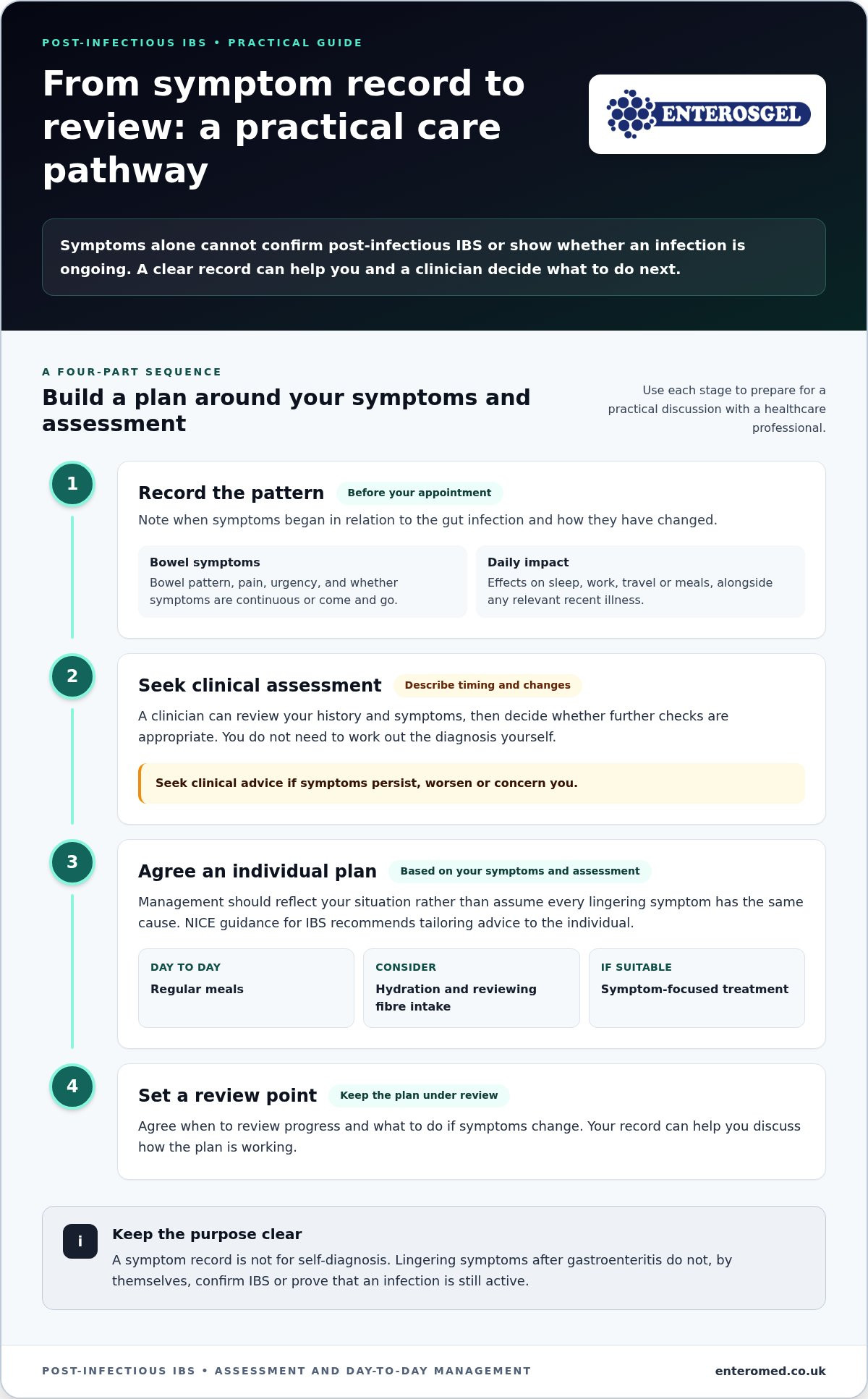
A practical plan starts by understanding the symptom pattern and checking whether another cause needs attention. You don’t need to work out the diagnosis yourself. A concise record can help a clinician review your history and symptoms and decide whether further checks are appropriate.
What should you record before speaking to a clinician?
Note when symptoms began in relation to the gut infection and how they have changed. Include your bowel pattern, pain, urgency and the effect on sleep, work, travel or meals. Record whether symptoms are continuous or come and go, along with any relevant recent illness. This isn’t for self-diagnosis; it gives you and your clinician a clear account to discuss.
What can a management plan include?
Management should reflect your symptoms and assessment rather than assume every lingering symptom has the same cause. Your clinician may discuss day-to-day adjustments, such as regular meals, hydration and reviewing fibre intake, or consider symptom-focused treatment. NICE guidance for IBS recommends tailoring advice to the individual. Agree when to review progress and what to do if symptoms change. This clinical IBS relief guide gives broader context on symptom management.
A useful sequence is:
- Record symptoms and their effect on daily life.
- Seek assessment and describe the timing of the initial illness and ongoing changes.
- Agree a plan with a clinician, including any checks or symptom-led options they recommend.
- Review what has changed and report new or worsening symptoms.
Get prompt medical advice if you have blood in your stool, unexplained weight loss, severe or worsening abdominal pain, or signs of dehydration. Contact your GP or NHS 111 for advice, and seek help sooner if you feel seriously unwell. Don’t assume these symptoms are part of IBS.
Once you’ve discussed assessment and general management, you can ask whether a drug-free approach may be relevant to your diarrhoea symptoms. Find information about ENTEROSGEL® in the product information. Any choice of post infectious IBS treatment should fit your clinical assessment, and persistent or changing symptoms warrant review.
Could ENTEROSGEL® help post-infectious IBS with diarrhoea?
For diarrhoea-predominant symptoms, ENTEROSGEL® may be an option to discuss after clinical assessment. It’s a CE-certified medical device and drug-free intestinal adsorbent, not a medicine. Evidence from IBS-D studies may inform a conversation about symptom support, but it doesn’t establish a specific effect on post-infectious IBS.
How does an intestinal adsorbent differ from a medicine?
ENTEROSGEL® works physically in the gut and isn’t absorbed into the bloodstream. It does not bind or capture bacteria. Instead, it captures bacterial toxins from pathogenic bacteria, which cause leaky gut and diarrhoea. Its intended focus is to reduce the duration of diarrhoea and the number of loose stools. It doesn’t diagnose an infection or replace assessment when symptoms persist or cause concern.
The product is available as an ENTEROSGEL® 225 g tube. Its local, non-systemic action differs from treatments that work through other mechanisms. Follow the product’s Instructions for Use. If you’re unsure whether it suits your circumstances, discuss this with a healthcare professional.
What should readers know about IBS-D use and evidence?
The RELIEVE IBS-D trial involved 440 people with IBS-D across 28 NHS sites in England. Published in GUT in 2022, it reported symptom relief in 37.4% of participants receiving ENTEROSGEL® compared with 24.3% receiving placebo. The study population had IBS-D, and the findings don’t show that participants had post-infectious IBS or establish a specific benefit for that subgroup.
For IBS-D treatment, use ENTEROSGEL® in 30-day courses, with each course followed by a short break. Do not exceed six doses per day. Follow the product’s Instructions for Use for dosing. Seek clinical advice if symptoms persist, worsen or are concerning.
ENTEROSGEL® may be an option to discuss for diarrhoea symptoms, but it isn’t a cure for post-infectious IBS. Explore the product information to learn more about its use, and seek clinical advice if symptoms continue or cause concern.
Take your next step with confidence
You don’t have to settle on a diagnosis or treatment plan alone. If symptoms continue, change or interfere with daily life, arrange a clinical review and use your symptom notes to discuss what should happen next. A clinician can help decide whether further assessment is needed and which options suit your situation.
For diarrhoea-predominant symptoms, ask whether a drug-free option could fit alongside your wider care plan. ENTEROSGEL® has been listed on the NHS Drug Tariff since 2023, but this does not establish a specific effect on post-infectious IBS. Consider the evidence and suitability in context.
Choosing a post infectious IBS treatment is a step-by-step process, not a test you have to pass on your own. Explore ENTEROSGEL® digestive support for product information, and seek clinical advice for persistent or concerning symptoms. With appropriate assessment and a plan you can review, you can move forward with greater clarity.
Frequently Asked Questions
Can an infection cause IBS?
Gastroenteritis can be followed by new IBS-type symptoms, but not everyone who has an infection develops IBS. The timing may suggest a post-infectious pattern, yet it doesn’t prove the cause or rule out other conditions. If bowel changes continue after the initial illness, note when they began and how they affect you, then arrange clinical assessment rather than assuming the infection or IBS is responsible.
How long can post-infectious IBS last?
There isn’t one reliable recovery timeline that applies to everyone. Symptoms may change over time, and their duration can’t be predicted simply because they followed an infection. Track whether bowel habits, pain or urgency are improving, stable or getting worse. If symptoms persist, worsen or interfere with everyday life, arrange a review with a clinician to discuss what should happen next.
How is post-infectious IBS diagnosed?
A clinician assesses your symptom history, including when bowel changes began and how they relate to the illness. They may ask about previous digestive symptoms, the pattern of pain and stools, and any other health changes. Depending on your history and examination, they’ll decide whether further checks are needed. Don’t diagnose yourself from timing alone: symptoms after infection can have causes other than IBS.
What is the best treatment for post-infectious IBS?
There’s no single best option for everyone; management depends on symptoms and clinical assessment. A plan may address the main difficulty, such as loose stools, pain or bloating, and should be reviewed if it isn’t helping or symptoms change. Research on IBS-D can inform discussions about diarrhoea-predominant symptoms, but it isn’t automatically evidence for post-infectious IBS. Agree suitable post infectious IBS treatment with a clinician.
Can ENTEROSGEL® help with IBS-D after an infection?
ENTEROSGEL® may be considered for diarrhoea symptoms after assessment, but evidence in IBS-D doesn’t establish a specific benefit for post-infectious IBS or prove a cure. It’s a drug-free intestinal adsorbent that acts locally in the gut and does not bind or capture bacteria. Instead, it captures bacterial toxins from pathogenic bacteria. If you’re considering it, read the Instructions for Use and discuss suitability with a clinician, especially if symptoms continue or you have concerns.
What symptoms after a gut infection need medical advice?
Contact your GP or NHS 111 for advice if you have blood in your stool, unexplained weight loss, worsening or severe abdominal pain, or signs of dehydration such as passing much less urine than usual. Seek urgent help if you’re becoming seriously unwell; call 999 for a life-threatening emergency. Don’t assume these symptoms are IBS or wait for them to pass without seeking appropriate medical advice.


