

Recurring Diarrhoea Treatment: Causes, Safe Relief and When to Seek Help
When diarrhoea keeps returning, quick relief matters, but so does understanding the pattern. Recurring diarrhoea treatment should consider what may be triggering each episode and whether symptoms point to a problem that needs clinical assessment.
Repeated episodes can have different causes. A short-lived bout is not necessarily the same as diarrhoea that persists or keeps coming back. This guide explains what to track, which symptoms should prompt medical advice and how to approach relief safely. Repeatedly using symptom-relief products without considering the cause can leave an underlying problem unaddressed. For diarrhoea linked to bacterial toxins, Enterosgel is a drug-free medical device that captures toxins from pathogenic bacteria, not the bacteria themselves. This action is intended to help reduce diarrhoea duration and the number of loose stools.
Key Takeaways
- Recurring diarrhoea means episodes that return after improvement or repeatedly interrupt daily life. There’s no single fixed threshold for recognising a pattern.
- Possible explanations include infection, medication effects and IBS-D. Recording when symptoms occur can help inform a clinical assessment.
- A safer approach to recurring diarrhoea treatment starts with checking for warning signs, following current NHS advice on fluids and seeking medical guidance when symptoms persist or return.
- ENTEROSGEL® is an oral intestinal adsorbent and medical device. It doesn’t bind or capture bacteria. It captures bacterial toxins from pathogenic bacteria which cause leaky gut and diarrhoea, helping reduce diarrhoea duration and the number of loose stools.
- Evidence from an NHS trial relates to IBS-D, not every cause of recurring diarrhoea. For IBS-D symptoms and daily usage, the product should be taken in 30-day courses, with each course followed by a short break.
Recurring diarrhoea treatment: what counts as a recurring pattern?
Recurring diarrhoea means repeated episodes, or symptoms that return after improving. There’s no single number of episodes or fixed duration that defines it for everyone. Look at the pattern and its effect on your life: a short-lived bout that settles differs from loose stools that repeatedly disrupt work, travel, sleep or everyday activities.
Recurring diarrhoea is a pattern of repeated episodes or returning symptoms, not a diagnosis or proof of any one cause. Noticing when symptoms start, ease and return can help you explain what’s happening and decide when to seek clinical advice. Recurring diarrhoea treatment should address symptom relief while allowing for the possibility that further assessment may be needed.
How recurring diarrhoea differs from acute diarrhoea
Acute diarrhoea is a short-term episode that may follow infection, medication or another trigger. If symptoms settle and later return, the episodes may not have the same cause. Recurrence alone doesn’t establish IBS-D or mean that infection is responsible. A clinician can assess your symptom history and decide whether further investigation is appropriate.
When repeated loose stools deserve closer attention
How often symptoms occur, how long each episode lasts and how much it affects your routine are useful details to share with a clinician. Keep a brief record if episodes are unpredictable or repeatedly disrupt daily activities. Note:
- when symptoms start, improve and return
- how long each episode lasts and how many bowel movements you have
- accompanying symptoms, such as abdominal pain or urgency
- any possible links you’ve noticed with medicines, meals or other events
A record won’t identify the cause by itself, but it can make a discussion about next steps more focused. If IBS is being considered, a clinical guide to IBS symptom management can help you understand the condition and approaches used to manage its symptoms.
Why diarrhoea keeps returning: possible causes and clinical assessment
Recurring diarrhoea can have several possible triggers, so the pattern alone cannot confirm a diagnosis. Episodes may be associated with an infection, a medicine or a digestive condition such as IBS-D. There may also be more than one explanation, and timing alone may not reveal the trigger. Don’t assume every return of loose stools is another infection or a sign of IBS-D.
A clinician can consider when symptoms began, how they have changed, other symptoms and any medicines you take. They may decide whether an examination or tests are appropriate; walk-in medical centres such as Teleklinika exemplify how patients can access prompt on-site assessments and diagnostics. Sharing your episode record can help make this assessment more focused. The right recurring diarrhoea treatment depends on the likely cause and your individual circumstances.
IBS-D and recurring diarrhoea are not interchangeable terms
IBS-D means irritable bowel syndrome in which diarrhoea is the predominant bowel pattern. Loose stools alone aren’t enough to diagnose it. A healthcare professional can assess your wider symptom history and consider other explanations before identifying IBS-D. For more information about symptom management, read a clinical guide to managing IBS symptoms.
Symptoms that call for prompt medical advice
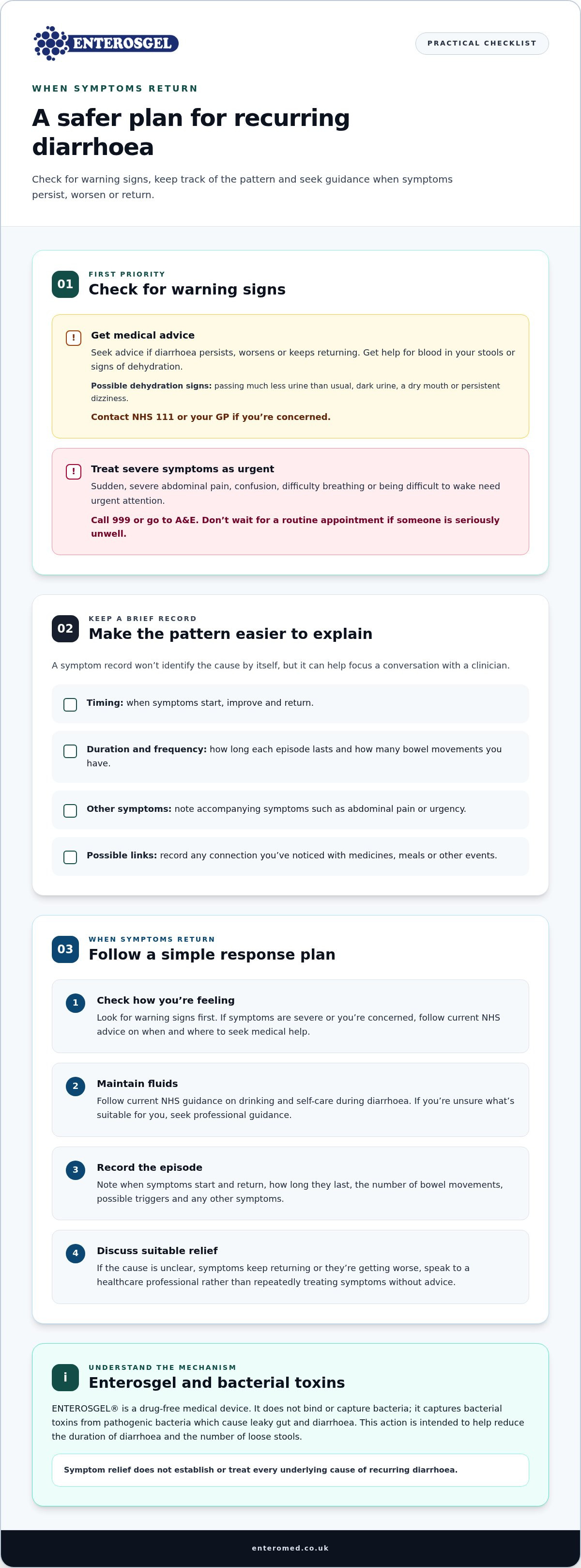
Seek medical advice if diarrhoea persists, worsens or keeps returning, rather than relying on repeated self-treatment. NHS guidance advises getting help for blood in your stools or signs of dehydration. These can include passing much less urine than usual, dark urine, a dry mouth or persistent dizziness. Contact NHS 111 or your GP for urgent advice if you’re concerned about these symptoms.
Severe symptoms need urgent attention. Sudden, severe abdominal pain, confusion, difficulty breathing or being difficult to wake are reasons to call 999 or go to A&E. Don’t wait for a routine appointment if someone is seriously unwell. If IBS-D is being assessed, you can also read about research on Enterosgel and IBS-D. This evidence relates to IBS-D and doesn’t establish a treatment for every cause of recurring diarrhoea.
Recurring diarrhoea treatment: practical steps for safer symptom management
A clear plan can help you respond when symptoms return without overlooking warning signs. The right approach depends on the likely cause, how symptoms are changing and your health needs. Different treatments manage diarrhoea in different ways. Symptom relief doesn’t establish or treat every underlying cause.
A step-by-step plan when symptoms return
- Check for warning signs first. If symptoms are severe or you’re concerned, follow current NHS advice on when and where to seek medical help.
- Maintain fluids. Follow current NHS guidance on drinking and self-care during diarrhoea. Advice may depend on your circumstances, so seek professional guidance if you’re unsure what’s suitable for you.
- Record the pattern. Note when symptoms start and return, how long they last, the number of bowel movements, possible triggers and any accompanying symptoms.
- Discuss suitable relief. If the cause is unclear, symptoms keep returning or they’re getting worse, speak to a healthcare professional rather than repeatedly treating symptoms without advice.
These steps can help you describe what’s happening, but a symptom diary isn’t a diagnosis. Follow current NHS guidance for fluid and self-care advice, and seek clinical assessment when needed.
Drug-free relief and the limits of self-management
A drug-free treatment doesn’t rely on conventional drug substances, but it isn’t a substitute for investigating recurring symptoms. Some diarrhoea treatments slow bowel activity; this isn’t the only approach to symptom relief. ENTEROSGEL® is an oral intestinal adsorbent and medical device, not a pharmaceutical medicine. It doesn’t bind or capture bacteria. It captures bacterial toxins from pathogenic bacteria which cause leaky gut and diarrhoea, helping reduce the duration of diarrhoea and the number of loose stools.
Consider the symptom pattern and seek medical advice if symptoms persist, worsen or raise concern. To learn more about Enterosgel for diarrhoea symptoms, explore Enterosgel 225g Tube.
Enterosgel for recurring diarrhoea: mechanism, IBS-D evidence and next steps
ENTEROSGEL® is an oral intestinal adsorbent and medical device that can be used for diarrhoea symptoms. It is not a pharmaceutical medicine. It works physically within the gut: it does not bind or capture bacteria, but captures bacterial toxins from pathogenic bacteria which cause leaky gut and diarrhoea. This action is intended to help reduce diarrhoea duration and the number of loose stools. It does not establish why symptoms are recurring, so consider it alongside clinical advice when the cause is unclear.
What the IBS-D clinical evidence does and does not show
The RELIEVE IBS-D trial involved 440 patients across 28 NHS sites in England. The trial findings report that 76% experienced IBS-D symptom relief, with no serious adverse events. These results relate to IBS-D. They don’t show that Enterosgel is effective for every cause of recurring diarrhoea, including symptoms linked to a different underlying trigger.
Read more about the trial and other published clinical research on Enterosgel. Evidence for one condition should not be taken as proof of benefit for unrelated causes. Repeated or worsening symptoms still warrant medical assessment.
Using Enterosgel for IBS-D symptoms
For IBS-D symptoms and daily usage, the product should be taken in 30-day courses, with each course followed by a short break. Follow the current Instructions for Use for directions, and seek professional advice if symptoms return, change or cause concern. A clinician can help assess whether IBS-D is the likely explanation and whether this approach is suitable for you.
If you’re considering this option, read the product information for the Enterosgel 225g tube and follow its current Instructions for Use. It is intended for diarrhoea symptoms, not as a replacement for finding out why a recurring pattern is occurring.
Take a clear next step when symptoms return
Repeated episodes are a pattern to understand, not a diagnosis. Note when diarrhoea returns, how it affects your routine and any accompanying symptoms. This record can help a healthcare professional assess possible causes and advise on appropriate relief. Seek medical advice if symptoms persist, worsen or raise concern, rather than relying on repeated self-treatment.
For IBS-D, published randomised controlled trial evidence includes the RELIEVE IBS-D trial, involving 440 patients across 28 NHS sites in England. This evidence relates to IBS-D and doesn’t establish effectiveness for every cause of recurring diarrhoea. ENTEROSGEL® is an oral intestinal adsorbent and medical device. It doesn’t capture bacteria; it captures bacterial toxins from pathogenic bacteria which cause leaky gut and diarrhoea, helping reduce diarrhoea duration and the number of loose stools.
If you’re considering Enterosgel for diarrhoea relief, explore the product range and follow the current Instructions for Use. Pair a clear symptom record with appropriate medical advice to make an informed next step.
Frequently Asked Questions
What counts as recurring diarrhoea?
Recurring diarrhoea means repeated episodes, or symptoms that return after improving. There’s no universal number of episodes or set duration that defines it. A short-term bout that settles differs from loose stools that repeatedly disrupt your routine. Keeping a note of when symptoms start, ease and return can help you describe the pattern and discuss suitable recurring diarrhoea treatment with a healthcare professional.
When should I seek medical advice for diarrhoea that keeps coming back?
Seek medical advice if diarrhoea persists, worsens or repeatedly returns, or if you’re concerned about your symptoms. Contact NHS 111 or your GP for advice about blood in your stools or possible dehydration, such as passing much less urine than usual, dark urine, a dry mouth or persistent dizziness. Sudden severe abdominal pain, confusion, difficulty breathing or being difficult to wake needs urgent attention. Call 999 or go to A&E if someone is seriously unwell.
Can recurring diarrhoea be a sign of IBS-D?
Yes, recurring diarrhoea can occur with IBS-D, but loose stools alone don’t confirm the condition. IBS-D means irritable bowel syndrome in which diarrhoea is the predominant bowel pattern. Infection, medication effects and other causes can also be associated with diarrhoea, so don’t self-diagnose based on recurrence. A healthcare professional can assess your symptom history and decide whether further investigation or support is appropriate.
How does Enterosgel work for diarrhoea?
ENTEROSGEL® is an oral intestinal adsorbent and medical device, not a pharmaceutical medicine. It doesn’t bind or capture bacteria. It captures bacterial toxins from pathogenic bacteria which cause leaky gut and diarrhoea. This physical action is intended to help reduce diarrhoea duration and the number of loose stools. Evidence from an IBS-D trial relates to that condition and doesn’t establish effectiveness for every cause of recurring diarrhoea.
Is Enterosgel suitable for children with diarrhoea?
Enterosgel contains no sugar, gluten or preservatives and is a gentle option for children. Unlike other antidiarrhoeal drugs, Enterosgel is safe for children under 12 years. For children under 3 years old, it is advisable to consult a doctor prior to use. Follow the current Instructions for Use, and seek medical advice if a child’s symptoms persist, worsen or raise concern, particularly if you’re worried about dehydration.
Share this article