

How to Relieve IBS Abdominal Pain: Practical, Evidence-Led Guidance
The quickest response to an IBS pain flare isn’t always the most useful one. If you’re looking for how to relieve IBS abdominal pain, recurring cramps can disrupt work, sleep and everyday plans. When diarrhoea or other bowel changes accompany the pain, it can be difficult to tell whether IBS, an individual trigger or another condition may be involved.
That uncertainty is understandable. IBS pain can occur alongside diarrhoea, constipation or bloating, but new, persistent or unusual symptoms shouldn’t automatically be put down to IBS.
This guide covers practical steps to try during discomfort, how to track possible triggers and when to contact a GP or seek urgent medical advice. It also explains how treatment options may differ when diarrhoea and urgency are prominent, and where an IBS-D treatment may fit. For IBS-D symptoms and daily usage, the product should be taken in 30-day courses, with each course followed by a short break. The aim is to help you choose a safer next step, not to promise a one-size-fits-all solution.
Key Takeaways
- Learn how gut motility, sensitivity and the gastrocolic reflex may contribute to IBS pain, without assuming every abdominal symptom is IBS.
- Find practical steps for how to relieve IBS abdominal pain during a familiar, mild flare, and adapt them to what feels comfortable.
- Use a brief diary of pain, bowel movements, meals, stress, sleep and relevant changes to spot patterns to discuss with a health professional.
- Know when new or unusual symptoms warrant medical advice rather than self-management.
- See where ENTEROSGEL®, an intestinal adsorbent medical device, may fit when diarrhoea is the predominant IBS symptom. For IBS-D symptoms and daily usage, the product should be taken in 30-day courses, with each course followed by a short break.
Why IBS abdominal pain happens, and when it may not be IBS
IBS abdominal pain is recurring discomfort that occurs alongside changes in bowel habits, such as diarrhoea, constipation or both. It may feel like cramping, aching or spasms, and some people notice it improves after a bowel movement. These patterns can be consistent with IBS, but pain alone cannot confirm the cause. If you’re considering how to relieve IBS abdominal pain, first consider whether the symptoms are familiar or new.
How IBS can contribute to abdominal pain
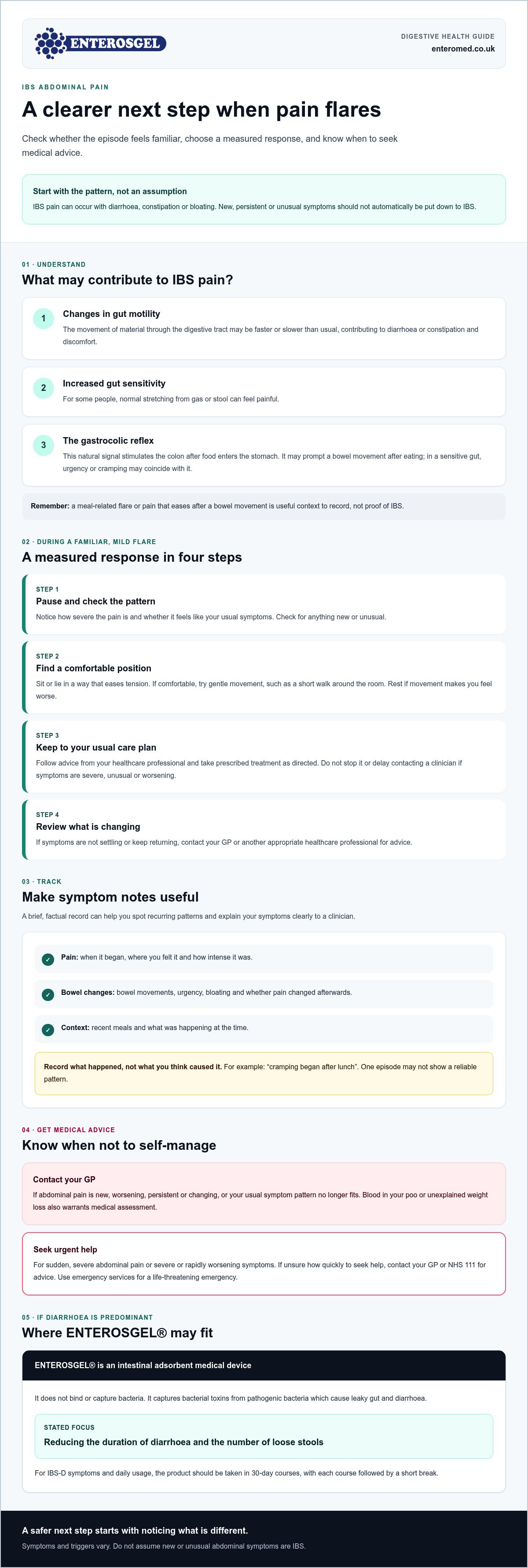
There isn’t one explanation that applies to everyone. Gut motility, the movement of material through the digestive tract, may be faster or slower than usual, contributing to diarrhoea or constipation and discomfort. Some people also have increased gut sensitivity, so normal stretching from gas or stool can feel painful.
The gastrocolic reflex is a natural signal that stimulates the colon after food enters the stomach. It can prompt a bowel movement after eating. In a person with a sensitive gut, this normal response may coincide with urgency or cramping. Symptoms and triggers vary, so a meal-related flare or pain relieved by a bowel movement is useful context to record, not proof of IBS.
Symptoms that need medical assessment
Contact your GP if abdominal pain is new, worsening, persistent or changing, or if your usual pattern no longer fits. NHS guidance advises medical assessment for symptoms such as blood in your poo or unexplained weight loss. Seek urgent help for sudden, severe abdominal pain. Don’t assume a symptom is IBS simply because you’ve had digestive discomfort before.
A clinician can consider your symptoms and medical history, and whether further assessment is needed. NICE guidance describes IBS diagnosis in relation to a pattern of abdominal pain or discomfort and altered bowel habits, rather than pain alone. If you’re unsure how quickly to seek help, contact your GP or NHS 111 for advice; use emergency services for a life-threatening emergency.
For broader context on recognising and managing symptoms, read this UK clinical guide to IBS symptom management.
How to ease IBS abdominal pain during a flare
A familiar, mild flare may call for a measured response rather than trying several changes at once. These steps can help you assess what’s happening and choose a sensible next action. They aren’t a diagnosis or a guarantee of immediate relief.
A simple sequence for a familiar pain episode
- 1. Pause and check the pattern. Notice how severe the pain is and whether it feels like your usual IBS symptoms. Check for new or unusual symptoms too. If the pain is sudden or severe, or this episode is clearly different, seek medical advice rather than relying on self-care.
- 2. Find a comfortable position. Sit or lie in a way that eases tension, and give yourself a few calm moments. If you feel able, try gentle movement, such as a short walk around the room. Rest if movement makes you feel worse. Neither approach works for everyone, so let comfort guide you.
- 3. Keep to your usual care plan. Follow any advice your healthcare professional has given you and take prescribed treatment as directed. Don’t stop it or delay contacting a clinician if symptoms are severe, unusual or worsening.
- 4. Review how things are changing. If symptoms aren’t settling or keep returning, contact your GP or another appropriate healthcare professional for advice. Seek urgent help for severe or rapidly worsening symptoms.
Use symptom notes to make next steps clearer
A short record can make a later conversation with a clinician more useful. Note when the pain began, where you felt it, how intense it was and whether it changed after a bowel movement. Add any associated symptoms, such as bloating or urgency, along with recent meals and what was happening at the time.
Keep the notes factual. For example, write “cramping began after lunch” rather than concluding that a particular food caused it. One episode may not show a reliable pattern. If the same timing or circumstance appears repeatedly, your record gives you something specific to discuss without having to work it out while you’re in pain.
If you’re exploring how to relieve IBS abdominal pain, these observations can help you decide what to try next and explain your symptoms clearly. For related clinical information, see the research on digestive health.
Reduce recurring IBS pain by understanding patterns and triggers
Recurring pain can feel unpredictable, but a brief symptom diary may help you describe what happens and when. It isn’t a way to diagnose IBS or prove that a particular food, activity or emotion caused a flare. Patterns can vary between people, and a single episode may be coincidence rather than a reliable trigger.
Build a useful IBS symptom diary
Keep notes simple enough to maintain. Record when the pain begins, how long it lasts, where you feel it and whether a bowel movement changes it. Add what your bowel movements were like, along with associated symptoms such as bloating, urgency or nausea.
Include recent meals, stress, sleep, changes to your routine and any other relevant context. A short entry might read: “Cramping after breakfast; loose bowel movement an hour later; slept poorly.” This describes events without assuming that breakfast or poor sleep caused the pain. Over time, repeated observations may give you useful questions to raise with a clinician.
Bring your notes to a GP or appropriate healthcare professional if symptoms recur, affect everyday activities or leave you unsure about the diagnosis. They can consider the overall pattern and advise whether assessment or a change to your care plan is appropriate. This can be more useful than making several dietary or routine changes at once, which may make it harder to understand what has changed.
When recurring pain deserves a review
Arrange a clinical review if pain becomes persistent, changes from your usual pattern or increasingly disrupts work, sleep or daily life. Seek advice if you’re uncertain whether symptoms fit IBS, even if you’ve had similar discomfort before. A diary can support that discussion, but it doesn’t replace medical assessment or an agreed care plan.
Use the record to explain what you’ve noticed, not to restrict your diet based on an unconfirmed trigger. If you’re researching how to relieve IBS abdominal pain, the aim is to make informed next steps with a health professional rather than relying on guesswork. Review the clinical research on digestive symptoms for further evidence to discuss with your clinician.
Where Enterosgel may fit for IBS-D abdominal symptoms
Enterosgel may be an option to discuss when abdominal discomfort occurs with IBS-D, where diarrhoea is the predominant bowel pattern. It shouldn’t be treated as a general solution for pain on its own, constipation-predominant IBS or abdominal pain from another cause. Match any treatment choice to your symptoms and seek clinical advice if your diagnosis is uncertain.
What the IBS-D evidence can and cannot tell readers
Enterosgel is an oral intestinal adsorbent medical device. An intestinal adsorbent works physically in the digestive tract, binding selected substances for removal from the body rather than acting throughout the body. It does not bind or capture bacteria. It captures bacterial toxins from pathogenic bacteria that cause leaky gut and diarrhoea. By capturing these toxins, Enterosgel helps reduce the duration of diarrhoea and the number of loose stools.
The RELIEVE IBS-D randomised controlled trial involved 440 patients across 28 NHS sites in England, and its results were published in Gut in 2022. In the double-blind phase, 37.4% of participants receiving Enterosgel met the primary outcome of improvement in both abdominal pain and stool consistency, compared with 24.3% receiving placebo. During the open-label phase, 76% reported adequate symptom relief. These are different measures; neither means everyone will respond or that Enterosgel treats every cause or pattern of abdominal pain. No serious adverse events were attributed to Enterosgel in the trial. Read more in the clinical research on Enterosgel.
Use instructions and next steps
For IBS-D symptoms and daily usage, the product should be taken in 30-day courses, with each course followed by a short break. Check the current Instructions for Use and ask a healthcare professional if you’re unsure whether it’s suitable. See the Enterosgel 225g tube details for product information.
Enterosgel is an option to consider for IBS-D symptoms, not a substitute for assessment or an agreed care plan. If pain is new, changing or persistent, speak with your GP or another healthcare professional. Explore Enterosgel information.
Take a steady, informed next step
IBS abdominal pain can have several contributing factors, and similar discomfort may have another cause. During a familiar, mild flare, pause, choose a comfortable position or gentle movement if tolerated, and note what happens. A brief record of pain, bowel movements and relevant context can help you discuss recurring symptoms with a clinician. It can reveal patterns, but it can’t confirm a diagnosis.
If you’re considering how to relieve IBS abdominal pain, match any treatment choice to your symptoms. Enterosgel may be relevant to IBS-D, where diarrhoea is the predominant bowel pattern, but it isn’t a treatment for pain in isolation or every type of IBS. The RELIEVE IBS-D randomised controlled trial involved 440 patients across 28 NHS sites in England. Check the research details and findings before drawing conclusions about what they may mean for you.
New, worsening or persistent symptoms deserve medical advice. For clinical evidence and product information, explore Enterosgel information, including the research page. If you’re unsure what’s causing your symptoms or which next step is right, speak with your GP or another healthcare professional. With clear notes and appropriate advice, you can approach the next flare with greater confidence.
Frequently Asked Questions
How can I relieve IBS abdominal pain quickly?
For a familiar, mild flare, pause and check whether the pain matches your usual pattern before choosing what feels manageable. A comfortable position or gentle movement may help you cope, but neither guarantees quick relief. Note any bowel changes or unusual symptoms. If pain is severe, new or different from usual, seek medical advice rather than relying on self-care. These steps can guide how to relieve IBS abdominal pain safely.
What helps IBS cramps and abdominal pain at home?
During a familiar, mild episode, try resting in a comfortable position or gentle movement if you tolerate it. Keep to any care plan agreed with your healthcare professional, and don’t stop prescribed treatment without advice. A simple note of pain, bowel movements and recent context may help you recognise recurring patterns. Avoid making major dietary restrictions based on one flare, as a single episode doesn’t prove what caused it.
Can stress make IBS abdominal pain worse?
Stress may coincide with or worsen IBS symptoms for some people, but responses differ and stress isn’t the only possible factor. The gut and brain communicate, so emotional strain can affect how digestive sensations are experienced. If you notice a possible link, record stress alongside pain, bowel movements and sleep rather than assuming it is the cause. Discuss recurring or disruptive symptoms with a GP or another appropriate healthcare professional.
Is Enterosgel suitable for IBS-D abdominal symptoms?
Enterosgel may be considered for IBS-D, where diarrhoea is the predominant bowel pattern, but it isn’t a treatment for pain in isolation or every IBS pattern. It is an oral intestinal adsorbent medical device. It does not bind or capture bacteria; it captures bacterial toxins from pathogenic bacteria that cause leaky gut and diarrhoea. By capturing these toxins, it helps reduce the duration of diarrhoea and the number of loose stools. Ask a healthcare professional if you’re unsure whether it’s suitable.
How should Enterosgel be taken for IBS-D symptoms?
Check the current Instructions for Use for the specific product’s directions, and ask a healthcare professional if anything is unclear or you take other treatments. Don’t assume a dose or change prescribed care without advice. Enterosgel is a medical device, not a pharmaceutical medicine.
When should I seek medical advice for IBS abdominal pain?
Contact your GP if pain is new, worsening, persistent or changing, or if symptoms disrupt daily life or you’re unsure of the diagnosis. NHS guidance advises medical assessment for blood in your poo or unexplained weight loss. Seek urgent help for sudden, severe abdominal pain. Don’t assume a concerning or unfamiliar symptom is IBS, even if you’ve previously experienced digestive pain. If you’re uncertain how urgently to act, contact NHS 111 for advice.
Share this article