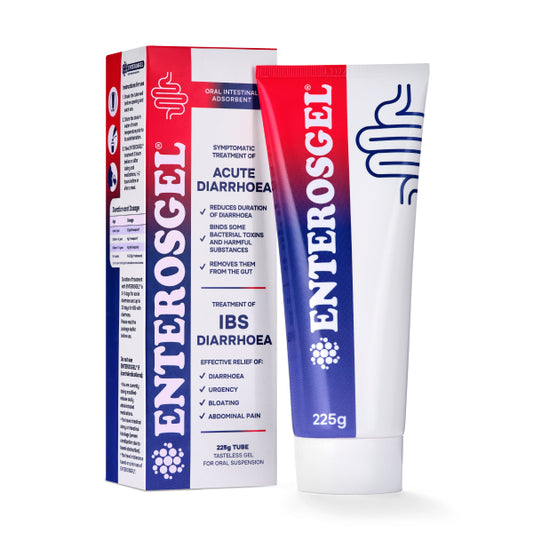
Relief That Travels With You: Relief That Travels With You

Essential protection against traveller’s diarrhoea, wherever you go.

  • All products
  • IBS & chronic diseases
  • Weight-Loss Diarrhoea
  • Antibiotic-Related Diarrhoea
  • Med-Effect Diarrhoea
  • Food & Allergies Diarrhoea
  • Gut Cleansing
  • Children's Diarrhoea
  • Traveller's Diarrhoea

ENTEROSGEL® has been proven to adsorb toxins from C. difficile, E. coli, Shigella, and viruses such as norovirus and rotavirus.

Two recent clinical studies on adults and children showed that ENTEROSGEL® can reduce the duration of acute diarrhoea and relieve associated symptoms.

Medical experts recommend ENTEROSGEL® to travellers heading abroad as an essential part of their first-aid kit. It’s a practical option to have on hand in case of food poisoning, deli belly or tummy bugs.

Trusted by UK healthcare—chosen for over 10 years

The #1 intestinal absorbent* and available at Boots for 10+ years.

#1 Intestinal Absorbent*

Approved by NHS

Sold at Boots for 10+ years

A trusted pharmacy partner for prescriptions & everyday health.

*Based on UK pharmacy sales data.

How to use

Follow these simple steps for best results

Step 1
Step 2
Step 3

Dosage guide

Age Dose How often to use
Under 1 year 2.5g (≈ 1/2 teaspoon) diluted in 7.5–15ml of water. 3 times daily
1 - 6 years old 5g (≈ 1 teaspoon) diluted in 50–100ml of water. 3 times daily
7 - 14 years old 10g (≈ 2 teaspoons) diluted in 50–100ml of water. 3 times daily
15 years+ and adults 15g to 22.5g (≈ 1 tablespoon or 1–1.5 sachet) diluted in 200ml of water. 3 times daily

ENTEROSGEL® 40 years of history, research and millions of patients treated.

76%

of patients that took ENTEROSGEL® reported adequate relief of their IBS symptoms.

Stat icon

1st

line treatment for IBS patients where diarrhoea and urgency are the main symptoms

Stat icon

7

top peer-reviewed journals have published research studies on ENTEROSGEL® efficacy and safety

Duration of the treatment with ENTEROSGEL®

3-5 days for acute diarrhoea

Up to 30 days for irritable bowel syndrome with diarrhoea. Pause between re-administration of at least 3 days.

It is recommended to consult a doctor before use in children under three years of age

In the beginning of the treatment (on day 1) you can double the first dose and then continue with a single dose after each bowel movement. Maximum 8 doses on the first day.

You can adjust the dose based on stool consistency - increase up to a double dose (max 3 times a day) if stools are loose, or reduce to one dose daily if stools are normal. Max 6 doses per day.

Traveller’s diarrhoea and it's dangers

What is Traveller’s diarrhoea?

Most people who travel will have experienced diarrhoea or frequent loose stools during their trip or shortly after their return home, this is classed as Traveller’s diarrhoea (TD). Unsurprisingly it is the most common illness related to travel internationally and worldwide affects a whopping 80 million travellers every year.

Estimates vary as to how often it occurs from 10-56% of travellers depending on whether you are travelling to a high-risk country, the season, where and what you eat and the types of activities you take part in. High-risk countries for TD include Central and South America, South and Southeast Asia and West, East and North Africa, or areas where sanitation and hygiene are poor. Although, outbreaks can also occur on cruise ships and hotels where people are in close contact.

Traveller’s diarrhoea symptoms

Most people understand that TD can develop from drinking or eating food that is contaminated with microorganisms such as bacteria or the toxins they release. However, diarrhoea can also be caused by a change in your diet, drinking more alcohol, stress from travel, or some people are just more susceptible. Bacteria such as Campylobacter, E.coliShigella and Salmonella are the most common causes followed by norovirus and rotavirus.  Parasites can also cause TD but tend to be less common.

According to the National Institute for Health and Care excellence (NICE), TD is the passing of 3 or more unformed stools (diarrhoea) within 24-hours, and at least one additional symptom including abdominal pain or cramps, nausea, vomiting, fever, or blood in the stools. It can be of mild, moderate or severe intensity, depending on if it prevents you from taking part in planned activities and is labelled “persistent” if it lasts for more than 2 weeks. Most people experience mild TD which lasts for 3-5 days, but it can be disturbing and often causes an urgent need to visit the toilet.

What can you do to manage TD?

The first step is rehydration which is especially important for children, elderly, pregnant women and those with pre-existing illnesses. To prevent dehydration, you can take oral rehydration salts mixed in clean water. These help with hydration and to correct electrolyte imbalances, but do not reduce the duration of diarrhoea or stool frequency.

Although adults can use loperamide or bismuth subsalicylate to relieve mild-moderate diarrhoea they should not be taken for longer than 2 days, or in children under 12 years, if you have a high fever (common in TD), or severe tummy pain, if you have blood or mucous in your stool, or those with inflammatory bowel disease. Both should be used with caution and the patient information leaflet followed directly, as they can have severe side effects. As loperamide slows gut motility, the microorganism causing the diarrhoea can remain in the gut for longer and people who are interested in improving their gut health are looking for safer alternatives.

Oral intestinal adsorbents such as ENTEROSGEL are another option that can be considered as an effective treatment for TD. ENTEROSGEL is classified as a medical device because of the way it works in the gut, removing bacterial toxins and viral particles, not being absorbed into the body and being completely expelled in the stools.  ENTEROSGEL offers a safe treatment option for children (from age 0+years) and adults and is available as an OTC treatment and on prescription. Scientific studies have shown it can capture bacterial toxins from E. coliC. difficile and Shigella and rotavirus which are known to cause TD in people. Clinical studies have proved it reduces the duration of all types of diarrhoea not just TD and is the only treatment available that is safe for children from 0+ years.

ENTEROSGEL has the advantage that it can be used as a treatment mixed in oral rehydration salts to reduce duration of diarrhoea and stool frequency, in all age groups even vulnerable patients, with only few minor side effects.

Although probiotics recently have become popular for many gut-related conditions. For TD the scientific literature currently doesn’t suggest any benefit from taking them, although they may help replenish the microbiome with beneficial bacteria after an episode.

Advice for travellers

There are currently no vaccines available to prevent TD, so prevention is your best means of defence. It’s important to follow basic food and water hygiene measures and be prepared by taking ORS and Enterosgel with you. You never know if you will be able to find these abroad.

Regular hand washing with soap can help prevent TD and although alcohol hand gel is useful, it is less effective than soap against some pathogens. It’s also a good idea to avoid buffets and street food, raw fish, salad and ice and to peel fruits and raw vegetables. You should also avoid swallowing any pool water when swimming, and use bottled water to drink and clean teeth.

Traveller’s diarrhoea relief sachets – on-the-go solution for stomach bugs abroad

Traveller’s diarrhoea and it's dangers

Read more
Mobile view of family traveling with kid with diarrhea preparation.

What Travellers Should Know

Read more